The Federal Reserve’s got quite the gold stash – a whopping 497,000 bars chillin’ in their vault! But here’s the kicker: they’re just the glorified babysitters. Most of that gleaming metal (98%) belongs to foreign governments and central banks, with Uncle Sam owning just a sliver. The Fed’s relationship with gold has evolved since ditching the gold standard in ’71, but they still keep it locked up tighter than Fort Knox. Those vault security protocols? Pure gold-standard paranoia. Dig deeper into this precious relationship…

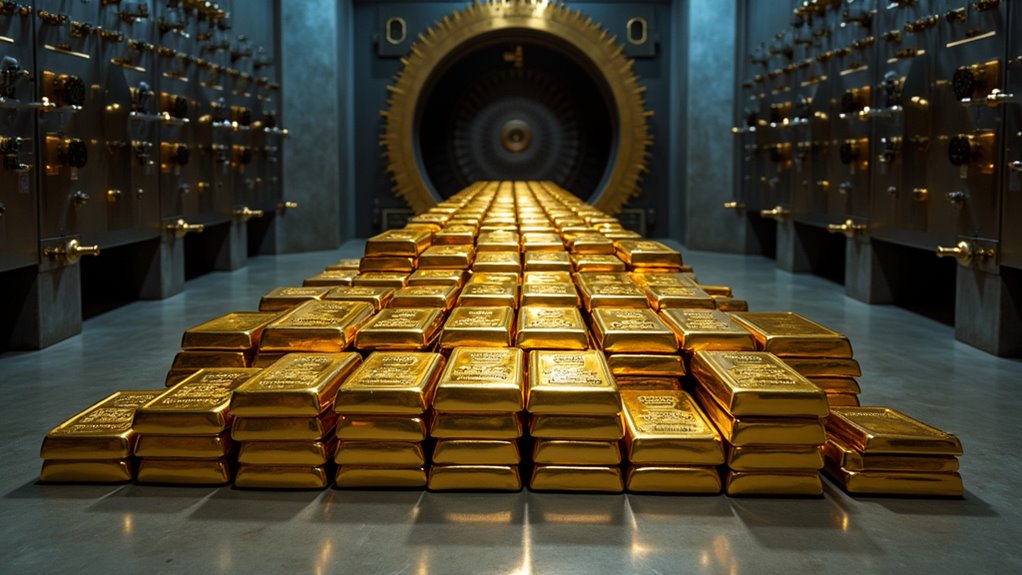
Glittering bars stacked in underground vaults tell only part of the Federal Reserve‘s fascinating relationship with gold. Deep beneath Manhattan’s bustling streets, the New York Fed‘s vault cradles a mind-boggling 497,000 gold bars – that’s 5,620 metric tons of pure, gleaming possibility! But here’s the kicker: the Fed doesn’t actually own any of this precious metal. Nope, they’re just really fancy babysitters.
The story gets juicier when you dig into history. From the 1830s until 1971, America was all-in on the gold standard, with the Fed required to keep 40% of its currency backed by the yellow stuff. Then came the game-changing Gold Reserve Act of 1934, which basically told the Fed, “Thanks, but we’ll take it from here,” transferring ownership to the Treasury and establishing that famous $35/oz price tag that defined the Bretton Woods era. The financial crisis of 1933 sparked massive gold outflows as people lost faith in banks and paper currency. Gold has since become a key tool for inflation hedging, helping to stabilize economies during turbulent times, and is now considered a core reserve asset by many central banks around the world, making it fundamental to global reserves. Gold’s enduring value as a hedge against economic instability has solidified its role in national and global finance, and it continues to serve as a safe haven during periods of economic turmoil.
America’s golden era stretched from the 1830s to 1971, until the Treasury swooped in to seize control and set gold’s destiny.
Today’s setup is a bit different – and honestly, kinda weird. The Fed holds gold certificates instead of actual gold, valued at an oddly specific $42.2222 per ounce (who came up with that number?!). Meanwhile, the vault itself is like Fort Knox’s cooler cousin, protected by a 140-ton steel and concrete frame that’d make any supervillain jealous. The Federal Open Market Committee meets eight times annually to make crucial monetary policy decisions that influence gold’s market value.

And don’t even think about trying to get in – it takes three people just to access the vault, which is monitored 24/7 by cameras that never blink.
The most fascinating part? A whopping 98% of the gold belongs to foreign central banks and governments. They choose the New York Fed as their golden safety deposit box because, let’s face it, nobody does security quite like Americans with something shiny to protect. The remaining 2% belongs to the U.S. and various international organizations, all tucked away in 122 separate compartments like the world’s most expensive storage facility.
The Fed’s relationship with gold still impacts markets today, albeit indirectly. When they fiddle with interest rates or launch another round of quantitative easing, gold prices dance in response. Investors often sprint to gold when inflation fears spike or the economy looks shaky – though trying to predict the correlation between Fed policy and gold prices is about as reliable as reading tea leaves.
The Exchange Stabilization Fund, created by that same 1934 Act, adds another layer of intrigue. This $2 billion Treasury piggy bank can buy and sell gold, currencies, and other financial instruments, operating through the New York Fed like a secret financial weapon.

They even broke it out during the 2008 crisis to insure money market mutual funds – talk about keeping some golden tricks up their sleeve!
Frequently Asked Questions
How Does Gold Price Manipulation Affect the Federal Reserve’s Monetary Policy?
Gold price manipulation creates significant headaches for the Fed’s monetary policy decisions.
When prices get artificially pushed around, it messes with the Fed’s ability to read inflation signals and economic health accurately. The distorted market can lead to misguided interest rate choices and policy timing.
Plus, when manipulation gets exposed, it chips away at the Fed’s credibility – making their policies less effective and harder to implement.
Can Individuals Store Personal Gold Holdings at Federal Reserve Banks?

Absolutely not – individuals can’t stash their personal gold in Federal Reserve vaults.
It’s a strict no-go zone! The Fed’s storage policy only welcomes official account holders like foreign governments and central banks, with the NY Fed being the main custodian.
Regular folks gotta look elsewhere for their precious metal safekeeping – think private vault companies, bank safety deposit boxes, or specialized depositories.
The Fed’s vaults? They’re exclusively for the big players.
What Happens to Federal Reserve Gold Reserves During Economic Sanctions?

Federal Reserve gold reserves remain largely unaffected during economic sanctions, as they’re legally protected under U.S. law.
The Fed’s gold holdings don’t fluctuate based on sanctions against other countries – they’re maintained as a stable monetary asset.
While sanctioned nations might scramble to boost their own gold reserves, the Fed’s massive gold vault stays steady.
It’s basically business as usual in those fortress-like vaults, sanctions or not!
Does the Federal Reserve Trade Gold With Other Central Banks?
The Federal Reserve doesn’t trade gold with other central banks – full stop!
Since abandoning the Gold Standard in ’71, the Fed’s been strictly hands-off when it comes to gold trading. Their role? Pure custodian vibes, baby – just storing the shiny stuff for Uncle Sam and foreign entities.
While other central banks are going wild with gold purchases (lookin’ at you, China!), the Fed’s stuck to its lane, dealing exclusively in securities for monetary policy moves.
How Often Does the Federal Reserve Conduct Physical Audits of Gold?
The Fed’s physical gold audits? Let’s get real – they’re not exactly frequent.
The last major audit was back in ’74 (yeah, that’s 1974!). These days, they mostly do annual seal checks for tampering and random compartment inspections through the OIG.
Full audits? Way too expensive – we’re talking $256M and 4 years to complete! Most “audits” are just spot checks, honestly.
The Treasury Secretary’s 2017 visit was the first looksy in 43 years. Wild, right?!