Successful gold hunting demands more than just wandering around with a cheap pan from your local outdoor store.
Smart prospectors invest in quality gear like the Proline Professional pan and specialised metal detectors – not the toy junk amateurs use.
Location research is essential; studying geological maps and joining prospecting clubs beats randomly digging in your backyard. Proper technique and legalities matter too – no one wants the cops showing up mid-pan. There’s a whole world of advanced methods waiting for those ready to take gold hunting seriously.

Every wannabe prospector dreams of striking it rich, but most are about as prepared as a koala in a swimming pool. They rush out with dollar-store pans and grand delusions, while seasoned prospectors quietly chuckle at their enthusiasm.

The truth is, successful gold hunting requires proper gear, technique, and a hefty dose of common sense.
Let’s cut through the rubbish – you’ll need some serious kit to get started. A quality gold pan like the 14″ Proline Professional isn’t just a fancy dish; it’s your bread and butter.
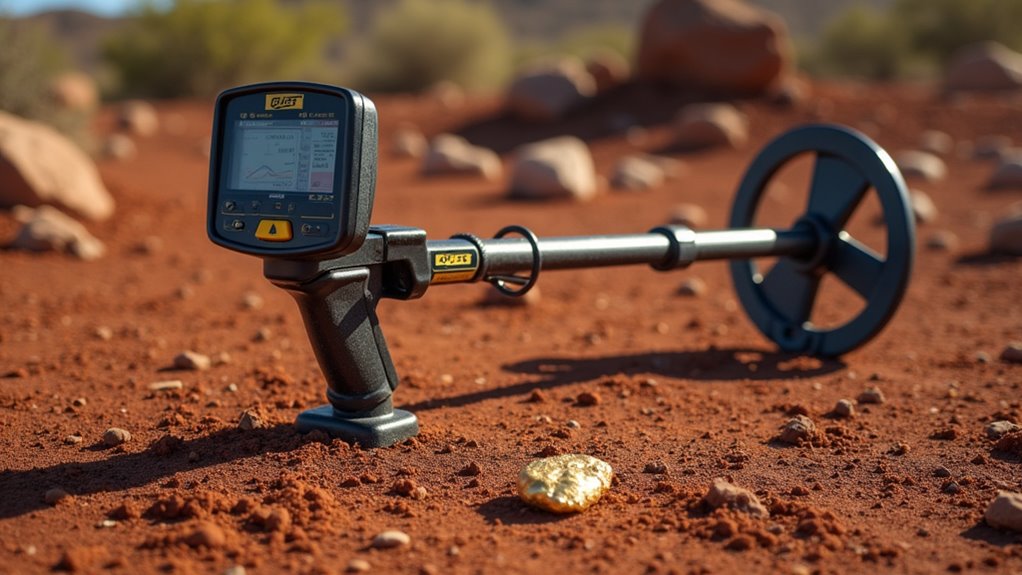
Chuck in a metal detector specifically designed for gold, and you’re already leagues ahead of the weekend warriors. Modern detectors with specialized search coils give you the best chance of finding those elusive nuggets, especially when targeting specific gold locations.
Skip the cheap gear if you want real results – invest in a proper gold pan and detector to outperform the amateurs.
And for those ready to graduate to the big leagues, a Gold Cube with a trommel topper will process more material than your arms ever could. Historical records of past mining activities can provide invaluable insights into potentially gold-rich areas.

Location is everything, and here’s where most rookies stuff up. While they’re fannying about in their backyard creek, smart prospectors are researching historical mining areas and studying geological maps like they’re preparing for their HSC.
Joining a local prospecting club might seem daggy, but these old-timers know where the yellow stuff hides. Plus, they’ve already made all the mistakes you’re about to make.
The actual panning technique isn’t rocket science, but it’s not finger painting either. You’ve got to develop a rhythm – swirl, wash, repeat. Black sand is your best mate; where it accumulates, gold often follows.
But don’t expect to nail it straight away. Most beginners lose more gold than they find until they’ve practiced proper technique.

For the gear heads who’ve mastered basic panning, there’s a whole world of fancy methods waiting. Sluicing, dredging, dry washing – each has its place and purpose. Highbanking combines the best of several worlds, but it’s about as subtle as a bull in a china shop.
Just remember, more equipment doesn’t automatically mean more gold.
Here’s the bit nobody wants to talk about – legalities and safety. Nothing ruins a prospecting trip faster than an angry landowner or a ranger with a fine book. Get your permits sorted, respect claim boundaries, and don’t be a galah about environmental impact.
And for heavens sake, bring proper safety gear and a first aid kit. Gold’s worthless if you’re dead.
To really boost your success rate, you’ve got to think like a pro. Use those black sand magnets, learn to spot different types of gold, and keep detailed records of where you’ve been.
The most successful prospectors aren’t necessarily the ones with the fanciest gear – they’re the ones who treat it like a proper craft instead of a get-rich-quick scheme. Now get out there and show those rocks who’s boss.
Frequently Asked Questions
Is Gold Hunting Legal in My State or Region?
Legal gold hunting varies wildly by location – it’s basically a regulatory minefield out there.
Most states allow recreational prospecting on public lands, but you’ll need permits and there’s heaps of red tape.

Here’s the deal: check with your local Bureau of Land Management office or state geological survey. They’ve got the specific rules for your patch.
Don’t just grab a pan and start digging, or you might cop a nasty fine!
How Much Money Can I Expect to Make Gold Hunting?
Let’s get real – gold hunting ain’t your ticket to riches, mate. Most prospectors earn between $40-53K annually, with the median sitting at $46,221.
Yeah, gold’s worth about $1,943 per ounce nowadays, but finding it? That’s the kicker.
Most folks treat it as a hobby that occasionally pays off. Sure, some hotshots make it big, but they’re rare as hen’s teeth.
Your success depends on location, gear quality, and plain ol’ luck.
Bottom line? Don’t quit your day job.
Do I Need Special Permits or Licenses to Hunt for Gold?
Yes – permits are essential. Don’t even think about skipping them unless you fancy a nasty fine.
Most states demand permits for public land prospecting, ranging from $10 to over a grand depending on your operation’s size. Private land? You’ll need the owner’s permission instead.
Different activities need different permits – from basic panning to serious dredging.
The red tape’s a pain, but it beats getting busted. Check local regs before ya start digging.
What Seasons or Weather Conditions Are Best for Gold Hunting?
Spring and summer are gold hunting champions – fact.
Snowmelt reveals fresh deposits in spring, while summer’s long days are perfect for putting in the hours.
Fall’s a sneaky good choice too – low water levels expose more riverbed gold.
Clear weather after heavy rain is pure gold hunting magic.
Those storms wash out new deposits, making it dead easy to spot that yellow shine.
Avoid extreme weather though – it’s not worth dying for.
Are There Gold Hunting Clubs or Communities I Can Join?
Gold prospecting clubs are everywhere – ya just gotta know where to look.
The GPAA is the biggest player, with 90+ chapters across the country and sweet mining claims members can use. Local clubs are gold mines for knowledge sharing and networking.
Online communities like GoldProspectors.org and Reddit’s r/goldpanning are packed with tips and banter.
Best part? Most clubs welcome newbies with open arms and actual mentoring.
Just show up ready to learn.