Gold’s role in ancient Asian civilizations transcended mere decoration. From Chinese emperors buried with massive golden hoards to Indian kings flaunting divine connections through golden crowns, this precious metal dominated cultural and spiritual life. Religious spaces sparkled with golden Buddhas and Hindu deities, while innovative rulers standardized gold coinage for trade. Ancient dental work even featured gold – these civilizations weren’t messing around! The surface has barely been scratched on gold’s epic Asian saga.

While modern investors obsess over gold’s latest price swings, ancient Asian civilizations were centuries ahead in recognizing this precious metal’s true value – and boy, did they go all-in. From temples dripping in golden splendor to intricate jewelry that would make today’s billionaires blush, gold wasn’t just about flexing wealth – it was deeply woven into the fabric of religious and cultural life.
Ancient Asian rulers didn’t just wear gold; they practically bathed in it. Indian kings rocked golden crowns and jewelry to show off their divine connections, while Chinese emperors took their gold obsession to the grave, quite literally. Their tombs were decked out with enough bling to make Fort Knox jealous. In fact, the sacred role of gold in these cultures was akin to that of the gold revered by the Incas, Mayans, and Aztecs.
And speaking of divine connections, gold was basically the VIP pass to the spiritual domain – temples across Asia used it to create sacred spaces that’d make modern megachurches look like corner stores. In fact, gold’s divine association was a crucial factor in its usage in many ancient cultures. This widespread reverence for gold can also be seen in how it is still considered a core reserve asset in various cultures today, often sourced through conflict-free practices to ensure its ethical acquisition.

The economic impact of gold was huge (like, seriously huge). Before someone got smart and invented coins, people were lugging around chunks of gold and trying to figure out if they were getting ripped off. Thank goodness for those Indian and Chinese innovators who standardized things with gold coinage, making trade way less awkward.
Plus, those Indian artisans? They were basically the Cartier of their time, crafting jaw-dropping pieces that had everyone from local elites to foreign traders reaching for their gold pouches.
Mining this stuff wasn’t exactly a walk in the park. While some folks were content panning for gold in rivers (think ancient version of those reality TV shows), others went full-on industrial with proper mining operations. Royal families in Southeast Asia weren’t about to let this liquid gold slip through their fingers – they controlled those mines like modern-day oil barons control their wells.
But here’s where it gets really interesting: gold wasn’t just about looking fancy or making trades. Ancient Asian civilizations used it for everything from dental work (yep, ancient bling teeth were a thing) to crafting religious statues that would make modern art installations look like kindergarten projects.

Buddhist temples featured golden Buddhas that literally glowed with spiritual significance, while Hindu deities like Vishnu and Shiva got the golden treatment too.
The cultural impact of gold in ancient Asia was so profound that its influence still echoes today. When these civilizations buried their dead, they didn’t just send them off with a nice outfit – they packed enough gold to fund a small nation. It’s like they were saying, “Death is temporary, but swag is forever.” And you thought modern-day gold bugs were intense! These ancient civilizations wrote the book on gold obsession, and they wrote it in solid 24-karat.
Frequently Asked Questions
How Did Ancient Asians Determine the Purity of Their Gold?
Ancient Asians were pretty slick with their gold-testing game! They mainly relied on touchstones – smooth black rocks that revealed gold’s purity through color streaks.
Fire assaying was the heavy-hitter method, using lead and bone ash crucibles to separate impurities.

They’d also get creative with basic observation tricks – sound tests, visual checks, and water displacement measurements.
These methods weren’t perfect, but hey, they got the job done for centuries!
What Religious Ceremonies Involved Gold in Ancient Asian Cultures?
Ancient Asian religious ceremonies were obsessed with gold! From Buddhist stupas dripping in golden ornaments to Hindu rituals where kings became living gods through golden adornments – this stuff was everywhere.
Temples went all-in with gold-covered statues and ritual objects. The most extra ceremonies? Definitely funerary rites, where they’d deck out the dead in gold to guarantee immortality.

Even cremations got the golden treatment – talk about going out in style!
Which Ancient Asian Civilization First Developed Gold Mining Techniques?
Archaeological evidence points to Central Asia’s Ural-Altai region as the pioneer of ancient gold mining techniques.
These early miners were crushing it with their innovative stream-diversion methods as far back as… well, way back!
While China and Persia later developed their own impressive mining ops, those first Central Asian prospectors were already working those sweet alluvial deposits when everyone else was still figuring out what that shiny yellow stuff even was.
How Did Gold Trade Routes Between Asian Civilizations Influence Cultural Exchange?
Gold trade routes created incredible cultural crossroads between Asian civilizations.
As merchants moved precious metals across networks like the Silk Road, they carried more than just wealth – they transported ideas, religious beliefs, and artistic techniques.
Cities like Wari-Bateshwar became melting pots where different metalworking styles merged.
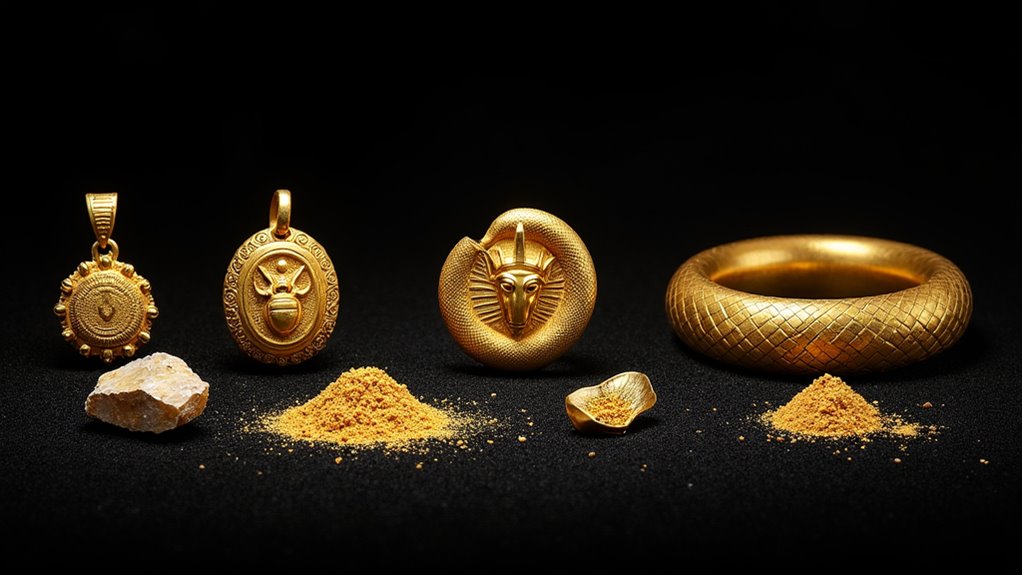
Buddhist artifacts made of gold spread alongside trade goods, while regional craftsmen exchanged innovative jewelry-making methods.
The routes literally goldplated cultural connections.
What Tools and Methods Were Used to Craft Gold Jewelry?
Ancient goldsmiths wielded an impressive arsenal of specialized tools. They’d heat their masterpieces with foot bellows and oil lamps, while bronze punches carved intricate details.

Small chisels sliced through hammered sheets like butter! Furnaces and bellows brought the heat for smelting, while paintbrushes delicately applied flux for those tricky granulation techniques.
The lost-wax method was pure genius – imagine pouring molten gold into clay molds shaped by vanishing wax!