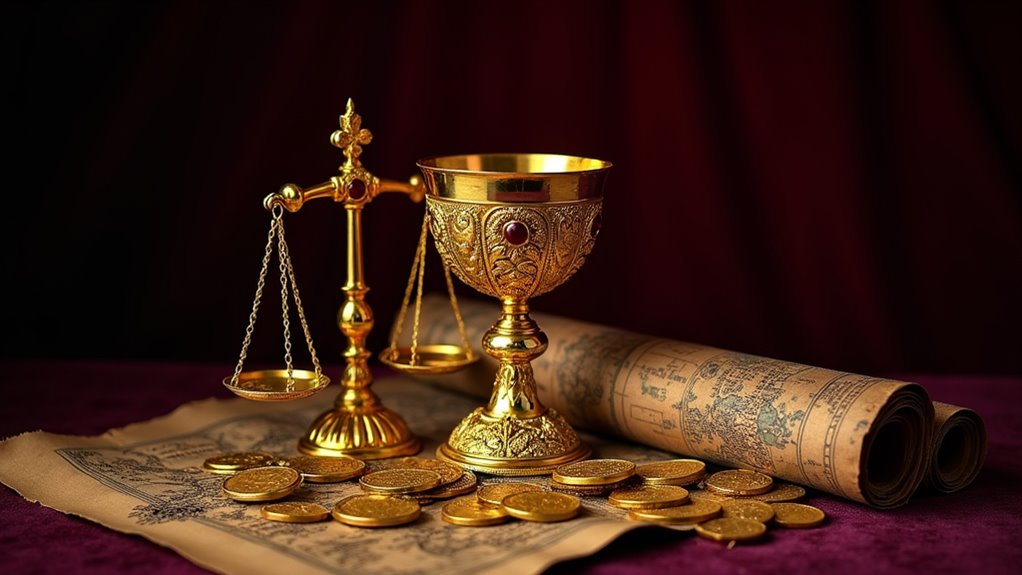
Gold’s architectural legacy spans millennia, from ancient Egyptian temples to Renaissance masterpieces like St. Peter’s Basilica. Civilizations consistently used this precious metal to symbolize divine connection and showcase wealth, plastering it on religious structures and incorporating it into intricate mosaics. Modern architects haven’t abandoned gold’s allure – they’ve evolved its application for both sustainability and aesthetics, as seen in Doha Tower’s gold-coated panels. This gleaming history of opulence and innovation barely scratches the surface.

Glitter and grandeur – gold’s romance with architecture stretches back to the dawn of civilization, where this precious metal transcended its monetary value to become the ultimate status symbol. Ancient Egyptians plastered their temples with it, convinced it was literally the flesh of their gods. Meanwhile, those show-off Greeks and Romans couldn’t resist slathering their religious structures in gold leaf, basically screaming “We’re loaded!” to anyone who’d look.
The Byzantines took this obsession to new heights, creating mind-blowing mosaics that made their churches look like they were lit from within. Seriously, these people knew how to work a room – their golden surfaces created an otherworldly glow that had visitors questioning whether they’d accidently stumbled into heaven.
Over in Asia, Chinese and Indian architects weren’t about to be outdone, incorporating gold elements that screamed both “we’re spiritual” and “we’re stupid rich.” The use of gold in ceremonial and ritual objects further emphasizes its significance in various cultural contexts. This cultural significance is often juxtaposed with the environmental impact of gold mining, raising questions about sustainability.

Then came the Renaissance – oh boy, did they know how to party with precious metals! St. Peter’s Basilica became the ultimate flex, with gold leaf practically dripping from every surface. Artists figured out that gold wasn’t just for showing off – it could actually make their work look luminous, creating effects that’d make modern lighting designers jealous.
These Renaissance smartypants basically wrote the book on how to use gold to make everything look expensive AF.
But gold’s not just about looking pretty – it’s got some serious cultural weight behind it. Across practically every civilization, it’s been the go-to symbol for power, success, and divine connection. Its associated with the sun in so many cultures, it’s like humanity collectively decided “Hey, you know what’s awesome? That big burning ball in the sky – let’s make our buildings match!” In ancient Egypt, gold was so revered that it was often linked to divine association, emphasizing its sacredness in their culture.
Fast forward to today, and architects are still crushing hard on gold, but now they’re trying to be all practical about it. Modern buildings like the Doha Tower use gold-coated panels that actually help with energy efficiency – how’s that for a humble brag? It’s like saying “We’re sustainable… but make it fashion.”

Contemporary designers have figured out how to make gold work in both minimal and maximal spaces, proving that this ancient material’s still got some new tricks up its sleeve.
Throughout history, interior designers have been particularly obsessed with the Midas touch. They’ve used it on everything from furniture to fixtures, creating spaces that practically scream “important people hang here.”
The technique of applying gold leaf became so refined, it turned into an art form all its own, with artisans developing methods that’d make today’s DIY enthusiasts weep with frustration.
Frequently Asked Questions
How Does Gold Leaf Maintain Its Luster Over Centuries of Architectural Use?
Gold leaf’s remarkable durability stems from its chemical inertness – it simply doesn’t react with air, moisture, or pollutants that typically tarnish other metals.

The ultra-thin application (we’re talking micrometers here!) minimizes physical stress, while gold’s natural resistance to UV rays prevents fading.
Traditional gilding techniques, perfected over millennia, create an incredibly strong bond with substrates.
Ancient artisans knew their stuff – their time-tested methods still shine through today’s urban grime.
What Alternatives to Gold Were Used in Ancient Architecture and Design?
Ancient architects got seriously creative when gold wasn’t an option! They turned to luxe colored stones and marble, crafting stunning mosaics that rivaled gold’s brilliance.

Bronze and copper alloys brought the bling factor, often gilded to fake that golden look.
Frescoes and painted finishes were the budget-friendly MVP’s, especially in Byzantine buildings.
And let’s not forget silver and tin – they weren’t gold, but hey, they still made things shine pretty darn good!
Can Modern Building Codes Restrict the Use of Gold in Architecture?
Modern building codes absolutely can throw a wrench in gold’s architectural ambitions!
While codes don’t explicitly ban gold, they’re sneaky about it – enforcing strict fire safety standards, structural requirements, and energy efficiency rules that make golden dreams harder to realize.
Environmental regulations are especially tough, side-eyeing gold’s sustainability credentials.
Plus, local jurisdictions often demand specific performance criteria that precious metals just can’t meet.
Talk about bureaucracy crushing the bling!
How Did Different Cultures Interpret the Symbolism of Gold in Design?
Different cultures developed fascinatingly unique interpretations of gold’s symbolism.

Ancient Egyptians saw it as divine power, while Chinese culture linked it to harmony and immortality.
In Islamic designs, gold represented paradise itself.
Hindu temples used it to channel divine energy, and Buddhist architecture embraced gold to symbolize enlightenment.
Even today’s modern designers can’t resist gold’s cross-cultural appeal, weaving ancient meanings into contemporary spaces with a distinctly luxe twist.
What Preservation Techniques Are Used for Gold-Decorated Historical Buildings Today?
Modern preservation of gold-decorated historical buildings combines cutting-edge science with traditional craftsmanship.
Conservators use XRF scanning and Raman spectroscopy to analyze deterioration, while master gilders apply time-tested restoration techniques.
Environmental controls protect against humidity damage, and UV filters shield delicate surfaces.
Regular maintenance includes micro-suction cleaning and protective coating applications.
Documentation guarantees every preservation step is traceable for future generations of conservators.