The infamous “Curse of the Pharaoh’s Gold” sparked global hysteria after Lord Carnarvon’s mysterious death following Tutankhamun’s tomb discovery in 1922. While no actual curse inscription existed, eleven people connected to the dig died within seven years – blamed on ancient pathogens and toxic mold rather than supernatural forces. The tomb’s magnificent treasures, including solid gold sandals and that iconic death mask, drove the sensationalist press into a frenzy. Modern science debunks the curse, but the story’s allure refuses to rest in peace.
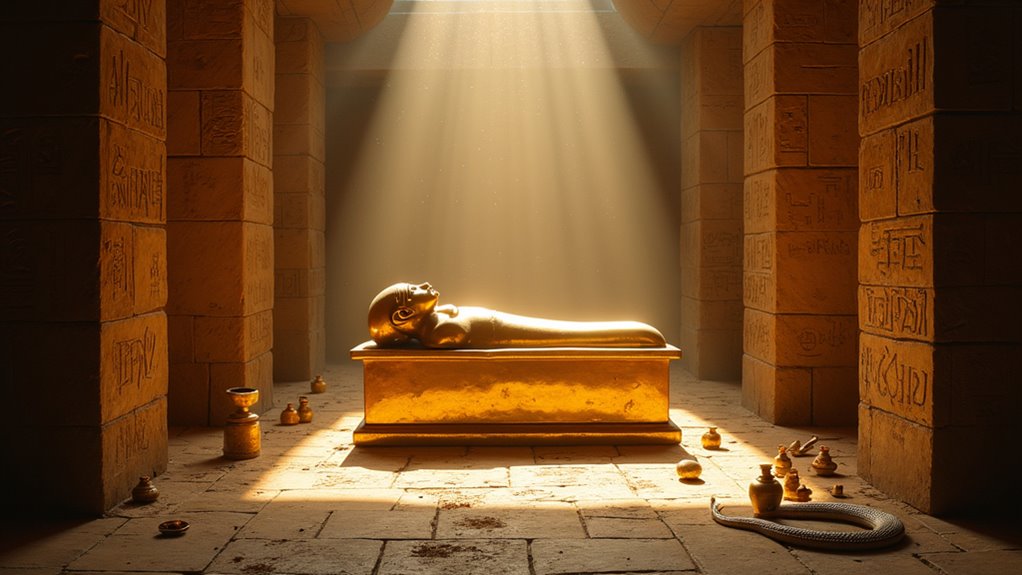
Few archaeological discoveries have sparked as much mystique and mayhem as the legendary Curse of the Pharaoh’s Gold – a tale that sent shivers through the scientific community after Howard Carter cracked open Tutankhamun’s tomb in 1922. What followed was a series of peculiar deaths that would cement this archaeological triumph as one of history’s most enigmatic treasure hunts.
The curse wasn’t just some modern media invention. Its roots stretched back to the 7th century AD, when ancient Egyptians embedded magical protections into their sacred burial sites. But it was Lord Carnarvon’s untimely demise – thanks to an infected mosquito bite – that truly set tongues wagging. Within seven years, eleven others connected to the dig would follow him to the grave, fueling whispers of supernatural vengeance.
Even Carter’s pet canary met a dramatic end, allegedly falling victim to a cobra – the very symbol of pharaonic protection. Yet here’s the kicker: despite popular belief, no curse inscription was ever found in King Tut’s tomb. The whole narrative was largely a product of sensationalist press coverage that capitalized on coincidence and superstition. Gold as a strategic reserve asset often serves as a hedge against uncertainty, much like the treasures hidden in the tomb. Additionally, the gold extracted from ancient sites today can be sourced through ethical mining practices that prioritize sustainability and responsibility.
The infamous curse, born from media sensationalism, twisted a cobra’s fatal encounter with Carter’s canary into supernatural Egyptian vengeance.

Scientists have since offered less mystical explanations for the deaths. Ancient pathogens, toxic mold, and the fungus Aspergillus lurking in tomb chambers likely played their part. Many victims simply succumbed to the era’s limited medical knowledge, pre-existing conditions, and the harsh realities of archaeological fieldwork in 1920s Egypt.
The tomb’s contents were genuinely breathtaking though – solid gold sandals, intricate amulets, and that iconic death mask adorned with protective deities. Each artifact spoke volumes about ancient Egyptian beliefs in safeguarding the dead. The mummy itself bore a royal apron and a peculiar star marking where the heart once beat, hinting at elaborate rituals we’re still trying to decode. The treasure hoarded by pharaohs, often in the form of strategic reserve assets, underscored their immense value in both wealth and culture.
The curse’s legacy extends far beyond its debunking. It revolutionized how we approach archaeological preservation and sparked a global obsession with Egyptology that refuses to die. Modern pop culture can’t get enough of the story, churning out countless documentaries and Hollywood blockbusters that keep the mystery alive.
Today, while science dismisses supernatural explanations, the Curse of the Pharaoh’s Gold remains a fascinating intersection of archaeology, media hysteria, and human imagination. It’s a reminder that sometimes the most valuable discoveries aren’t the gleaming artifacts themselves, but the stories they inspire – stories that continue to captivate audiences a century later, mixing fact with fiction in an irresistible golden blend that defies rational explanation. Furthermore, the sustainable practices in modern archaeology aim to minimize environmental impact and preserve the integrity of sites like Tutankhamun’s tomb, ensuring that future generations can connect with our past in a meaningful way.
Frequently Asked Questions
How Many People Died Mysteriously After Discovering King Tut’s Tomb?
According to historical records, approximately 10 people connected to King Tut’s tomb died within 12 years of its 1922 discovery.
The most notable was Lord Carnarvon, who died from an infected mosquito bite.

While media sensationalized these deaths as “mysterious,” many victims were elderly or already ill.
Howard Carter, the lead archaeologist, lived another 17 years after opening the tomb – kinda puts a dent in that whole “deadly curse” thing, doesnt it?
Are There Scientific Explanations for Deaths Linked to Ancient Egyptian Curses?
Scientists have identified several rational explanations for mysterious deaths associated with ancient Egyptian tombs.
Toxic substances used in mummification, including arsenic and mercury, remained potent for centuries. Dangerous fungi and bacteria thrived in sealed chambers, while radiation from naturally-occurring materials may have contributed to fatalities.

Psychological factors also played a role – anxiety from curse beliefs could impair judgment and lead to accidents during excavations.
What Protective Measures Do Modern Archaeologists Take Against Potential Tomb Curses?
Modern archaeologists rely on science, not superstition, when exploring ancient tombs. They employ thorough safety protocols: protective suits shield against harmful microbes, air sampling detects toxic gases, and ground-penetrating radar spots structural weaknesses.
Mental health support helps teams cope with curse-related anxiety, while non-invasive tech like 3D scanning reduces physical contact. It’s all about managing real risks – those ancient curses don’t stand a chance against modern tech!
Do Egyptian Museums Report Supernatural Incidents Related to Cursed Artifacts?
Egyptian museums occasionally report unexplained incidents around certain artifacts, though documentation remains largely anecdotal.
Staff members have described mysterious footsteps, inexplicable temperature drops, and objects moving without explanation.

The Egyptian Museum in Cairo has witnessed several such occurrences, particularly around royal mummies.
However, most institutions maintain professional skepticism, attributing these events to natural causes like old building infrastructure or overactive imaginations.
Which Pharaoh’s Tomb Is Considered to Have the Most Powerful Curse?
King Tutankhamun’s tomb certainly holds the title for most powerful “curse,” though ironically no actual curse inscription was found inside.
The deaths of Lord Carnarvon and 20+ others connected to its 1922 discovery created the ultimate spooky legend.

While other pharaohs’ tombs had legit curse warnings – like Ankhtifi’s spiritual threats – none reached Tut’s level of infamy.
The media frenzy and mysterious deaths made his curse the stuff of nightmares.