
The glitter at Sutter’s Mill sparked pure mayhem! When James Marshall spotted those golden flakes on January 24, 1848, news spread like wildfire despite John Sutter’s attempts to keep it hush-hush. Within months, 4,000 fortune seekers descended on California, growing to a whopping 300,000 prospectors from across the globe. By 1853, they’d extracted $2 billion in gold (1850s dollars), transforming sleepy California into a bustling economic powerhouse. The story behind this historic rush runs even deeper.

The single most electrifying moment in California’s history sparked on January 24, 1848, when James W. Marshall spotted something gleaming in the American River while constructing a mill race at Sutter’s Mill. That glint would transform a sleepy territory into a frenzied boom state, though John Sutter desperately tried to keep the discovery under wraps. Fat chance of that happening – news travels faster than a prospector’s pickaxe can swing.
By August of that same year, 4,000 fortune seekers were already scratching at the earth, and that was just the beginning. The flood gates burst open as word spread across continents, drawing an estimated 300,000 people from places as far-flung as China, Mexico, and Australia. Poor John Sutter watched helplessly as miners overran his property, helping themselves to his livestock and basically treating his land like an all-you-can-grab buffet.
The numbers were staggering – $2 billion in gold extracted by 1853 (and that’s in 1850s dollars, folks!). But here’s the kicker: most of those starry-eyed “forty-niners” ended up with nothing but callused hands and empty pockets. Meanwhile, instant cities like San Francisco exploded from the ground like mushrooms after rain, creating a multi-ethnic melting pot that would forever change California’s cultural landscape.

The Gold Rush didn’t just reshape society – it literally reshaped the earth itself. Miners tore into the Sierra Nevada like hungry bears, leaving environmental devastation in their wake. Rivers were diverted, forests cleared, and when simple panning wasn’t enough, they invented hydraulic mining. Because apparently, blasting mountainsides with high-pressure water seemed like a totally reasonable idea at the time. The environmental consequences of such practices would later lead to a push for sustainable gold mining methods to mitigate damage, emphasizing the need for next-gen exploration tools that minimize ecological impact. Additionally, the rush for gold highlighted the strategic value of national gold reserves, which many countries began to recognize as crucial for economic stability.
Infrastructure boomed faster than you could say “there’s gold in them hills.” Ports bustled with activity, telegraph lines stretched across previously empty terrain, and steamships chugged up and down rivers loaded with supplies and hopeful miners. The industrial revolution hit California like a freight train – speaking of which, railroads soon followed, connecting the goldfields to civilization.
But not everyone struck it rich in this golden age. Native American communities faced a devastating triple threat: displacement, disease, and outright violence. Their lands were seized, their populations decimated by foreign illnesses, and their way of life forever altered by the flood of settlers who seemed to think “finders keepers” applied to occupied territory.
The discovery at Sutter’s Mill did more than reveal gold – it revealed human nature in all its glory and ugliness. It showed how a single discovery could transform a territory into a state, turn ordinary folks into risk-taking entrepreneurs, and reshape both the physical and social landscape of an entire region. Central banks today still recognize gold’s value as a core reserve asset, emphasizing its historic significance and stability in times of economic uncertainty.

California would never be the same, and neither would the nation that suddenly found itself with a new El Dorado on its western edge.
Frequently Asked Questions
What Did John Sutter Originally Plan to Build at Sutter’s Mill?
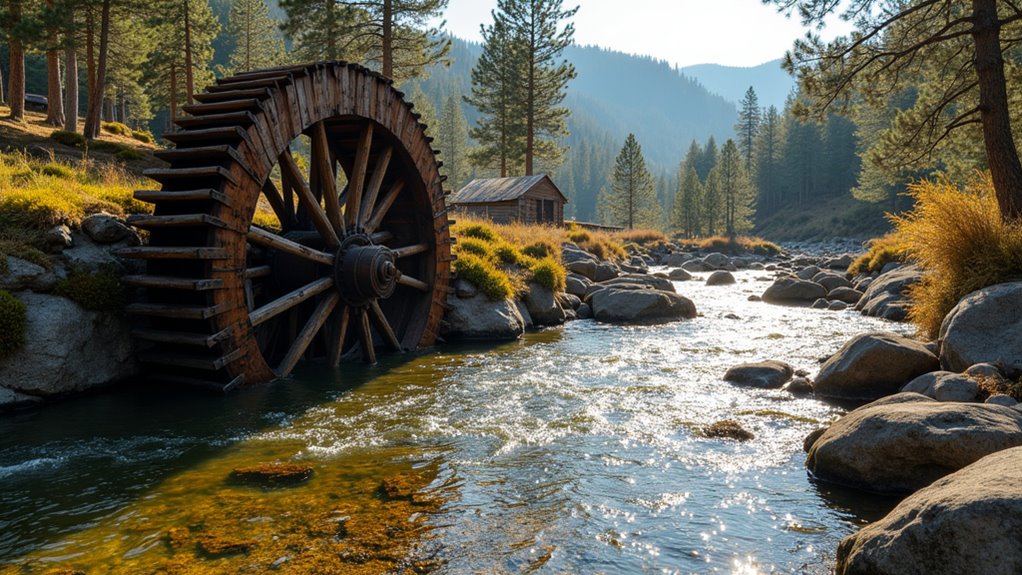
John Sutter’s original vision for the site was decidedly un-glittery – he planned to build a water-powered sawmill to process timber from the Sierra Nevada foothills.
Partnering with carpenter James Marshall, Sutter wanted the mill to produce lumber for his expanding settlement, New Helvetia.
The mill was meant to supply building materials for homes, shops, and other structures in his colony.

Talk about irony – the site meant for cutting wood ended up launching the greatest gold rush ever!
How Many People Died During Their Journey to California’s Gold Fields?
Historical records suggest approximately 1 in 12 Gold Rush migrants died during their perilous journey to California’s goldfields.
That’s a staggering mortality rate! Disease was the biggest killer, with cholera wreaking absolute havoc along the trails.
Between treacherous river crossings, snake bites, and wagon accidents, the 2,000-mile trek proved deadly for thousands.

Those who chose the sea route weren’t much safer – ships became floating petri dishes for infectious outbreaks.
What Happened to James Marshall After His Historic Gold Discovery?
Despite discovering the gold that sparked California’s epic rush, James Marshall’s life took a brutal nosedive.
His sawmill venture collapsed when workers ditched him for gold prospecting. He tried everything – mining, farming, even started a vineyard in Coloma – but nothing stuck.
Broke and bitter, he drifted around California taking odd jobs. The state threw him a lifeline with a pension in 1872, but he died poor in 1885.

Talk about ironic twists!
How Much Was an Ounce of Gold Worth in 1848?
In 1848, gold commanded a fixed price of $20.67 per troy ounce in the United States – a value that wasn’t going anywhere fast thanks to Congress’s iron grip via the Coinage Act of 1834.
Talk about stability! That amount packed some serious purchasing power, equivalent to roughly $700 in today’s cash.
While modern prices swing wild like a drunk pendulum, back then the gold standard kept things locked down tighter than Fort Knox.
Which Countries Sent the Most Immigrants During the Gold Rush?
The California Gold Rush turned into a global magnet, drawing immigrants from across the world.

Mexico led the pack thanks to its next-door location, while China sent thousands from its southeastern regions.
The Irish, fleeing the potato famine, made up a whopping 15% of foreign-born Californians.
Germans weren’t far behind at 10%.
Australia and New Zealand shipped their fair share of experienced miners too.
Talk about an international gold-fever party!