The SS Central America, nicknamed “Ship of Gold,” met its tragic fate in 1857 when a hurricane sent it plunging 7,000 feet deep off South Carolina’s coast. This disaster didn’t just claim 425 lives – it triggered the Panic of 1857 by taking $8 million in California gold to the ocean floor. In 1988, Tommy Thompson’s crew finally struck gold, recovering three tons of treasure using cutting-edge robotics. There’s more to this glittering tale than meets the eye.

The SS Central America‘s tragic demise stands as one of America’s most legendary maritime disasters – a tale where California gold, mother nature, and human ambition collided in spectacular fashion.
Originally christened as the SS George Law in 1852, this magnificent 280-foot sidewheel steamer played an essential role in connecting the gold-rich West with the money-hungry East during the California Gold Rush. Operating under the United States Mail Steamship Company, she shuttled precious cargo between Central America and the U.S. East Coast, earning her legendary “Ship of Gold” moniker.
The vessel’s final voyage began innocently enough on September 3, 1857, departing Colon, Panama, with a mind-boggling payload – over 11 tons of gold valued at $8 million (that’s a whopping $765 million in today’s cash). But Mother Nature had other plans. On September 11, the ship encountered a monster hurricane off South Carolina’s coast. With failing mechanics and deteriorating conditions, the mighty vessel succumbed to the depths at 8 p.m. the following day, taking 425 souls with her – though 153 managed to escape death’s cold grip. Gold has historically been viewed as a safe haven asset during times of economic instability, which adds to the significance of this cargo. Additionally, the importance of gold in central bank reserves highlights its enduring value in times of crisis, especially considering its role in global financial stability.
Sailing with $8 million in gold, the SS Central America met her fate in a hurricane, claiming 425 lives off South Carolina.

The economic aftermath was brutal, folks. This wasn’t just any old shipwreck; it was a financial atomic bomb that helped trigger the Panic of 1857. Banks trembled, commerce stuttered, and the East Coast’s economy took a serious punch to the gut. The loss of mail and gold created a ripple effect that exposed just how fragile 19th-century maritime commerce really was.
Fast forward 132 years to 1988, when salvage mastermind Tommy Thompson led a team that finally located the wreck 7,000 feet beneath the waves off South Carolina. Using cutting-edge underwater robotics and sonar tech that would make James Cameron jealous, they managed to haul up three tons of glittering treasure.
But here’s the kicker – the recovery sparked more drama than a daytime soap opera, with legal battles over ownership that continue to make lawyers rich.
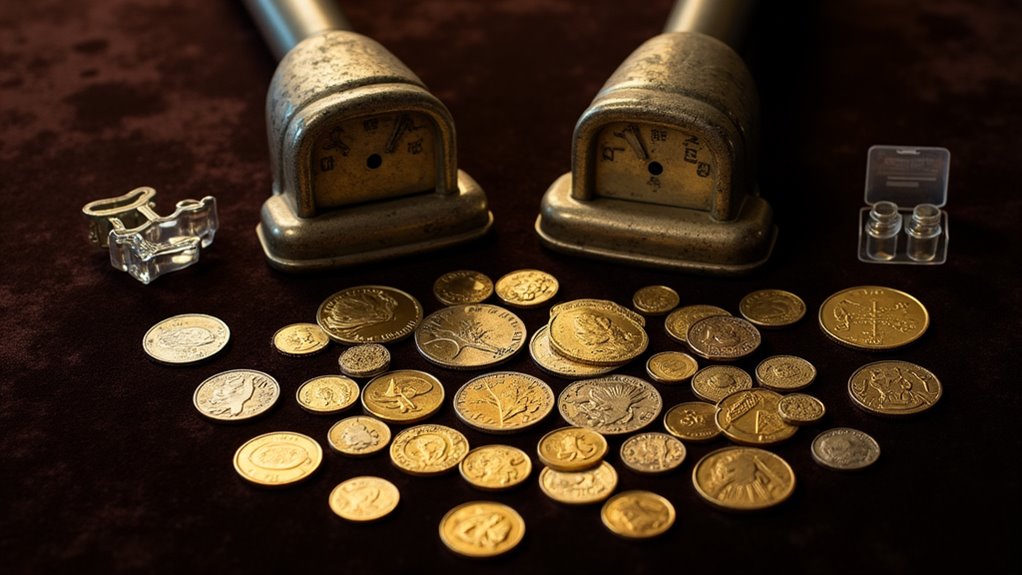
The ship’s legacy lives on through museum exhibits, documentaries, and countless studies. It’s a reflection of human ingenuity, greed, and the raw power of nature. The recovery efforts revolutionized deep-sea salvage techniques, setting new standards for marine archaeology and treasure hunting. Each gold bar and coin pulled from the depths tells a story of the California Gold Rush era, when fortunes were made and lost on the high seas.

The SS Central America remains a fascinating cautionary tale about the risks of maritime commerce and the allure of gold, and it serves as a reminder of the importance of sustainable practices in preventing environmental damage from mining activities. Its story continues to captivate treasure hunters, historians, and gold bugs alike, proving that some shipwrecks never truly die – they just get more valuable with time.
Frequently Asked Questions
How Many Survivors Were There From the SS Central America Disaster?
The SS Central America disaster saw 153 survivors from a total of 578 passengers and crew – a mere 26.5% survival rate.
Pretty grim stuff. The Norwegian vessel Ellen snagged about 50 men from the waters, while all women and children (around 149) made it out alive.
Three more stubborn souls were found days later, having drifted an insane 400 miles from the wreck. Talk about beating the odds!
What Modern Technologies Were Used to Locate the Shipwreck?

The discovery team deployed an impressive arsenal of cutting-edge tech to pinpoint this deep-sea treasure.
Side-scan sonar systems mapped the seafloor at a crushing 8,500-foot depth, while sophisticated ROVs like ZEUS prowled the abyss with high-res cameras and mechanical arms.
The real game-changer? Acoustic tracking systems – Ranger 2 USBL and Sonardyne SPRINT – which delivered insane precision (we’re talking 0.15-meter accuracy) in the murky depths!
How Much Gold Still Remains Undiscovered in the Wreckage Today?
Based on known recoveries and original estimates, roughly 8-9 tons of gold likely remain scattered across the SS Central America’s debris field.
That’s a whopping $500+ million at today’s prices!

But here’s the kicker – nobody knows for sure.
Between undocumented passenger gold and 160 years of ocean currents playing hide-and-seek with the treasure, the exact amount’s a mystery that keeps treasure hunters tossin’ and turnin’ at night.
What Happened to the Families of Passengers Who Perished?
The families of lost passengers faced devastating financial and emotional hardships. Many were ruined when breadwinners perished, while others lost fortunes in gold.
Legal battles dragged on for decades with virtually no compensation. The 19th-century system offered little recourse, and insurance claims mostly focused on cargo, not lives lost.

Families often resorted to selling personal accounts and relics to survive, while some faced cruel social stigma’s from unproven accusations of cowardice.
Did Any Personal Belongings or Letters Survive in Readable Condition?
While most organic materials succumbed to the ocean’s appetite, some personal belongings managed to survive the deep’s brutal embrace.
The star survivor? A pristine daguerreotype dubbed the “Mona Lisa of the Deep” – talk about beating the odds!
Gold-framed spectacles, brass luggage tags, and fancy decanters also made it through the centuries.

But letters? Tough luck there – the saltwater showed no mercy to paper artifacts, leaving those stories forever untold.