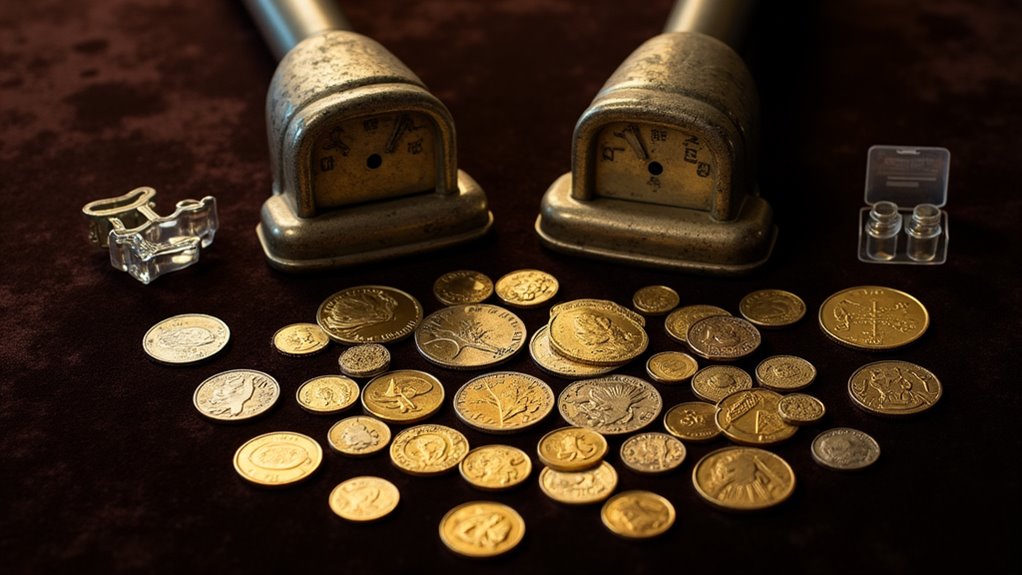
Assay offices serve as the ultimate truth-tellers in the glittering world of gold authenticity. These facilities deploy an arsenal of high-tech methods – from traditional fire assays at scorching 1650°F to non-destructive XRF testing that rivals CSI precision. Expert technicians wield precision scales sensitive to 0.1 milligrams, applying hallmarks that act like precious metal passports. The results? Independent verification that separates genuine bling from fool’s gold. There’s more to this golden tale than meets the eye.

While countless gold buyers have been burned by fake jewelry and questionable dealers over the centuries, modern gold purity testing has evolved into a fascinating science that leaves little room for deception. Assay offices stand as the gatekeepers of precious metal authenticity, wielding an arsenal of sophisticated testing methods that would make medieval alchemists weep with envy.
These specialized facilities employ multiple testing techniques, each with its own strengths and peculiarities. The legendary fire assay remains the gold standard – pun absolutely intended. It’s a brutal but beautiful process where samples are literally sacrificed to the testing gods at a scorching 1650°F, mixed with lead and filtered through bone ash cupels until only pure gold remains. This highly accurate method ensures the most precise results possible in determining gold content. Sure, it destroys the sample, but nothing else comes close to its accuracy. Results are typically delivered within three working days. The fire assay method is widely regarded for its scientific validity and is essential in determining the true value of gold, making it a cornerstone of assay hallmarking. Additionally, it has been used for centuries and is still the preferred choice for gold purity testing in many professional settings. In fact, fire assaying is the most trusted method for determining millesimal fineness, which is crucial for accurate gold valuation.
Fire assay: where gold meets its maker at 1650°F, delivering unmatched accuracy through ancient metallurgical sacrifice.
For those who’d rather keep their gold intact, XRF testing offers a high-tech alternative. These machines blast samples with X-rays and measure the resulting fluorescent light, determining gold content with impressive precision. It’s like CSI meets jewelry testing, minus the dramatic background music and impossible zoom-enhance sequences. The results are accurate within 15 parts per thousand – not too shabby for a non-destructive method.

The ancient touchstone technique still has its place in the modern assay office, though it’s more art than science. Seasoned testers can estimate gold purity by drawing metal across a dark stone and comparing the streak to known samples. It’s like reading tea leaves, except it actually works (most of the time). While less accurate than other methods, it’s quick and requires minimal equipment.
Assay offices don’t just test – they’re also responsible for hallmarking, the process of certifying precious metal purity. Using precision scales that can measure differences of 0.1 milligrams, they analyze samples and apply appropriate marks. These tiny stamps or laser engravings tell a metal’s entire life story: its purity, where it was tested, and even when it was certified. It’s basically a passport for precious metals.
The equipment in these facilities would make any tech enthusiast drool – high-temperature furnaces that could probably melt a small car, microscopes that reveal the smallest imperfections, and XRF spectrometers that look like they belong in a sci-fi movie.
But it’s not just about having fancy toys – assay offices serve as independent arbiters of quality, protecting consumers from fraud and ensuring compliance with international standards.

In an industry where a fraction of a percent can mean thousands of dollars, these facilities provide the essential service of objective verification. They’re the reason you can trust that 18k gold ring is actually 75% pure gold, and not just really shiny brass. Without them, we’d all still be biting coins and hoping for the best.
Frequently Asked Questions
How Long Does It Take to Receive Assay Office Test Results?
Test result times from assay offices vary wildly, from instant readings to several days of nail-biting anticipation.
While basic electronic testers spit out results faster than you can say “24k,” traditional fire assays keep you waiting 3 whole days!
Most offices deliver within 1-3 business days, though premium rush services can speed things up – for a price.

Peak seasons and complex samples might stretch those timelines, so don’t hold your breath too long.
What Happens if My Gold Item Fails the Purity Test?
When gold items flunk purity tests, it’s game over for that coveted hallmark!
The piece gets kicked back to its maker faster than you can say “below standard.”
Here’s the deal: manufacturers can either refine it to boost purity, adjust the alloy mix, or – if things are really dire – wave goodbye as it heads for destruction.
Sometimes, they’ll settle for certifying it at a lower purity level.
But watch out – intentional misrepresentation? That’s asking for legal trouble!
Do Assay Offices Test Gold Jewelry With Gemstones Attached?
Yes, assay offices routinely test gold jewelry with gemstones, but they’ve gotta get creative about it!
They primarily use non-destructive methods like XRF testing, working through gaps between stones or testing exposed metal areas.

When stones interfere with readings, they’ll take multiple measurements from different spots.
Some pieces might need stone removal by expert jewelers, but that’s a last resort – nobody wants to risk damaging those precious rocks!
Can I Witness the Testing Process at an Assay Office?
Most assay offices let customers witness their gold testing – it’s a thing! Just schedule ahead and expect to pay extra fees.
You’ll get a safety briefing, watch from designated spots (no running wild in the lab!), and actually see how they handle your precious metals.

But heads up – some tests like fire assay are off-limits for viewing.
Pro tip: not every office offers this, so definately check first before getting your hopes up.
Are There Mobile Assay Testing Services for Large Gold Collections?
Mobile assay services are absolutely crushing it for large gold collections!
Companies now roll up with high-tech XRF analyzers and portable labs – no more schlepping treasures across town. They’ll test right where your gold lives, which is perfect for massive collections or items that’d be a nightmare to move.
Sure, these mobile units might not match fixed-lab precision, but they’re nailing the sweet spot between convenience and reliable results.
Just watch those calibration requirements!