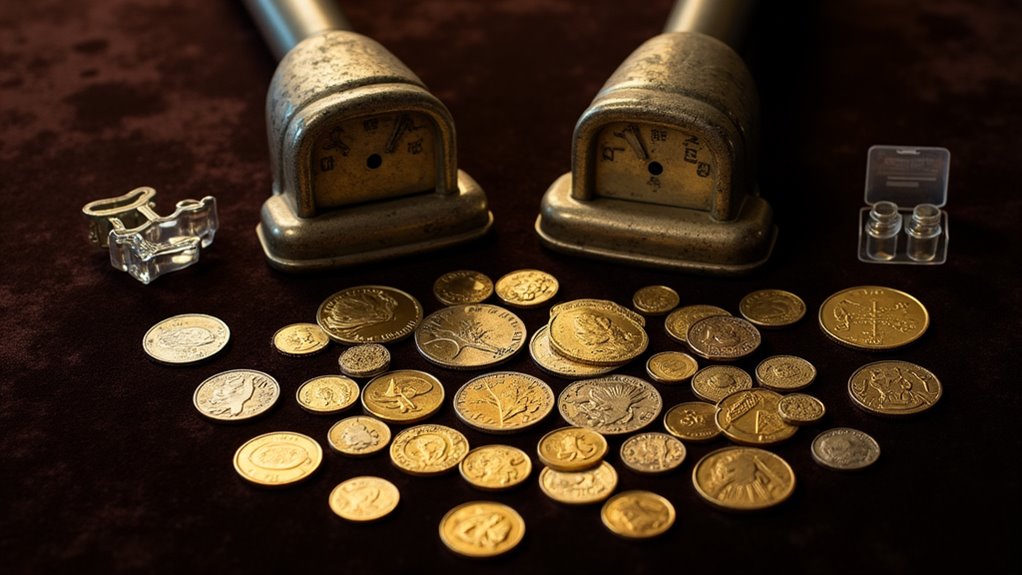
ISO standards bring order to precious metals chaos through rigorous technical requirements. The crucial ISO 9202 sets fineness ranges, while ISO 11426 verifies purity claims through fire assay methods. Non-destructive testing like ED-XRF helps confirm jewelry without damage. These voluntary standards facilitate global trade and maintain quality across the industry – from mine to market. Recent updates in 2024 have modernized requirements, making the standards more relevant than ever. There’s way more beneath this glistening surface.

While gold bugs might obsess over purity and provenance, it’s the unsexy world of ISO standards that actually keeps the precious metals industry from descending into chaos. The International Organization for Standardization’s Technical Committee 174 serves as the unsung hero, developing rigorous standards that govern everything from those gleaming 1-kilo gold bars to the tiniest pieces of platinum jewelry. Users should note that JavaScript is required to access the complete ISO standards documentation online. The standard’s most recent update in May 2024 ensures continued alignment with current industry needs and promotes good delivery standards that enhance trust in the market.
Let’s get real – without ISO 9202 setting the fineness ranges for precious metal alloys, we’d be swimming in a sea of questionable gold claims. This standard lays down the law for gold, silver, platinum, and palladium alloys, though it strategically keeps its nose out of solder territory. And when someone claims their gold is “pure,” ISO 11426 steps in with its fire assay method, ready to call their bluff through cupellation – a process that literally separates the precious from the worthless. Assay offices play a crucial role in this verification process, ensuring that purity claims are backed by reliable testing, while certifications like Fairmined and Fairtrade provide additional assurance of ethical sourcing practices.
The big boys of the gold world – those hefty 1-kilo bars – have their own rulebook in ISO 24018. Every bar must wear its ID proudly: manufacturer, weight, fineness, and a unique serial number (because heaven forbid we mix up our 999.9‰ bars). Speaking of purity, the standard’s got limits for 15 different impurities, cause nobody wants their “pure” gold bar contaminated with unwanted extras.

But wait – there’s more! ISO 23345 brings some high-tech swagger to the party with non-destructive testing using ED-XRF. It’s like X-ray vision for jewelry, minus the whole destroying-the-piece-to-test-it problem. And lets be honest, who wants their Cartier bracelet melted down just to check if it’s legit?
The ISO committee isn’t resting on its laurels, either. They’re currently cooking up new standards for analyzing ridiculously pure gold (we’re talking 999.999‰ here) using fancy techniques like ICP-MS and SPARK-OES. Because apparently, 99.99% pure just isn’t pure enough anymore for some people.
At its core, ISO’s role in the precious metals industry is kinda like being the responsible adult at a wild party – setting boundaries, maintaining order, and making sure everyone plays nice. These standards facilitate global trade, boost quality assurance, and help keep things ethical. Without them, we’d probably still be arguing about whether that chunk of yellow metal is actually gold or just really shiny brass.
The beauty of ISO standards lies in their voluntary nature – nobody’s forced to follow them, but everybody knows they’d be crazy not too. They’re the invisible force that keeps the industry from becoming a free-for-all of dubious claims and questionable practices.

And while they might not be as exciting as a gold rush or as dramatic as a market crash, these standards are what make the modern precious metals market possible. Now that’s something worth its weight in gold.
Frequently Asked Questions
How Long Does It Take to Get ISO Certification for Precious Metals?
The ISO certification timeline for precious metals typically spans 3-6 months – though it can stretch to a year for bigger operations.
Ain’t no quick fix here! Stage 1 audit takes 1-2 days, while Stage 2 drags on for about a week.
The whole shebang depends on your operation’s size, existing systems, and how many locations you’re juggling.

Pro tip: Having solid management systems already in place can speed things up considerably.
What Are the Costs Associated With ISO Certification for Gold Dealers?
ISO certification costs for gold dealers typically range from $10,000 to $15,000 initially, with prices varying based on company size and complexity.
There’s the upfront hit – around $5,700-$15,000 for prep work, plus $3,500-$5,000 for that first audit (ouch!).
Don’t forget the yearly maintenance fees and those pesky surveillance audits.

Smaller dealers might catch a break, but larger operations? Better have deep pockets.
Pro tip: local registrars save some serious cash.
Can Small-Scale Precious Metal Refineries Apply for ISO Certification?
Small-scale precious metal refineries can absolutely snag ISO certification – it’s not just for the big players!
They’ll need to buckle down and meet quality management standards, but the process is totally doable.

The real kicker? These tiny refineries gotta document everything, undergo assessments, and commit to continuous improvement.
Sure, it’s a bit of work upfront, but the payoff in credibility and market access makes it worth the hustle!
Does ISO Certification Guarantee Better Prices for Precious Metals?
ISO certification doesn’t guarantee better precious metal prices – that’s just not how markets work!
While certification builds trust and opens doors to premium buyers, actual prices still dance to supply-demand dynamics.

Sure, some certified dealers might snag better deals through enhanced credibility and market access, but it’s no golden ticket to higher prices.
Think of ISO as a badge of quality that might help seal deals, not inflate ’em.
How Often Must Precious Metal Businesses Renew Their ISO Certification?
Precious metal businesses must renew their ISO certification every 3 years – no exceptions!
Between these major renewals, they’re required to pass yearly surveillance audits to keep their cert valid.
Smart operators start the renewal process 6 months before expiration (because nobody wants that certification gap drama).
The process involves internal audits, fixing any issues, and passing that final recertification audit.
Miss the deadline? That precious certification becomes worthless!