Gold purity certification combines old-school fire assay (still the gold standard!) with modern tech like XRF analysis. Fire assay melts samples at scorching temps to separate pure gold from impurities – brutal but effective. Quick-and-dirty methods include acid testing and specific gravity checks, while non-destructive XRF scanning provides rapid results without destroying precious pieces. Each technique trades speed for accuracy – but there’s way more to this fascinating certification story than meets the eye.

Pure gold may be precious, but proving its purity? That’s where things get seriously interesting. The world of gold certification is a complex dance of chemistry, physics, and sometimes straight-up destruction – all in the name of determining just how pure that shiny piece really is.
The fire assay process stands tall as the undisputed champion of gold testing methods. It’s like the ultimate sacrifice play – literally melting down gold samples in a specialized environment to separate the pure stuff from everything else. Sure, it’s expensive and requires some serious expertise, but when you need absolute certainty about your gold’s purity, nothing else comes close to this bad boy. This method has been the standard for testing gold purity for centuries due to its accuracy and reliability. The modern adaptation of this process often utilizes induction furnaces for faster and cleaner results, although mercury exposure remains a concern in some traditional methods.
But hey, not everyone’s ready to melt down their precious metals! That’s where acid testing swoops in like a budget-friendly superhero. Scratch the surface, add some nitric or hydrochloric acid, and watch the show. Pure gold just sits there looking smug while lesser metals fizz and change color. It’s not as precise as fire assay, but it’ll definitely tell you if someone’s trying to pass off fool’s gold as the real deal.

Modern technology’s thrown some fascinating tools into the mix, too. Electronic conductivity testing is like giving gold a lie detector test – pure gold’s got signature conductivity patterns that are harder to fake than a celebrity’s smile.
And then there’s X-ray fluorescence (XRF) testing, which basically gives you gold’s entire life story without leaving a scratch. It’s like CSI for precious metals, minus the dramatic background music. This method is often preferred in industrial gold refining due to its non-destructive nature and rapid results.
For those who prefer old-school methods with a twist, specific gravity testing relies on good ol’ Archimedes’ principle. Compare your gold’s weight in water versus air, and voilà – you’ve got yourself a pretty decent purity indicator. It’s not winning any accuracy awards, but it’s perfect for quick checks on larger items like those chunky gold bars collecting dust in your vault (we wish!).
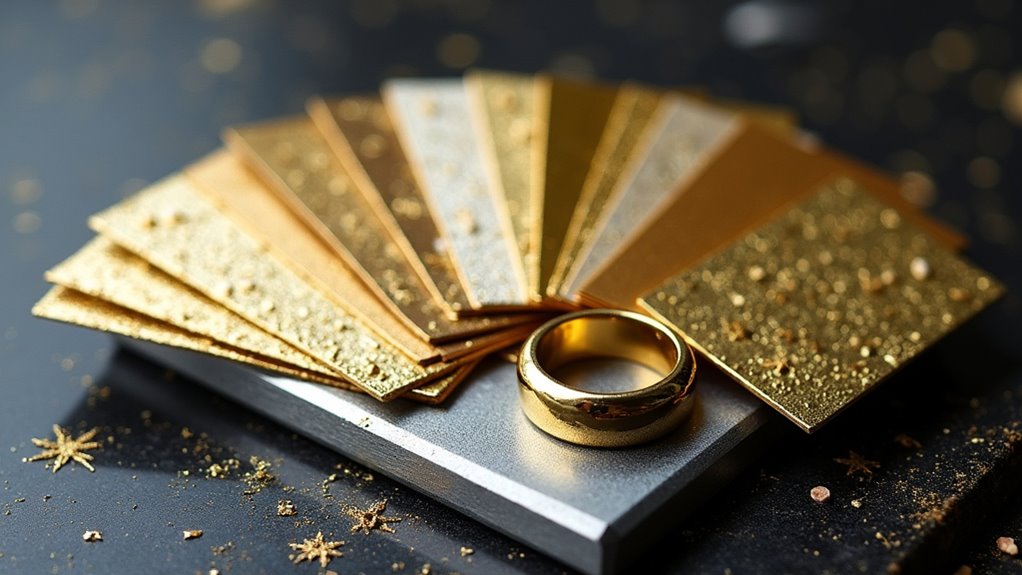
The simplest methods involve checking hallmarks and performing physical tests, which sounds about as exciting as watching paint dry – until you realize these basic checks have been catching counterfeiters for centuries. A magnet and an unglazed ceramic tile can tell you more about your gold than you’d think, though they’re more like opening acts than headliners in the assaying world.

In this high-stakes game of “prove it’s pure,” each testing method has its moment to shine. From the destructive drama of fire assay to the high-tech elegance of XRF analysis, gold certification is a fascinating blend of ancient wisdom and cutting-edge science. Because at the end of the day, when someone says “it’s solid gold,” you better be damn sure they mean it – down to the last decimal point.
Frequently Asked Questions
How Long Does a Complete Gold Assay Certification Process Typically Take?
The typical gold assay certification process varies wildly depending on the chosen method.
XRF testing wraps up in under an hour, while fire assays demand 24-72 hours for full results.
Factor in sample prep (30 mins), actual testing (1-3 hrs), and certification paperwork (1-2 hrs), and you’re looking at anywhere from same-day service to three days total.

Rush jobs exist but they’ll cost ya – big time.
What Happens if Counterfeit Gold Is Discovered During Certification?
When counterfeit gold surfaces during certification, it triggers an immediate chain reaction. Assayers flag the piece and document their findings using advanced testing methods.
The suspicious items get quarantined faster than you can say “fool’s gold,” while authorities are notified. Legal consequences follow – think investigations, potential criminal charges, and financial penalties.
Meanwhile, the market gets jittery, certification standards tighten up, and buyers start demanding extra proof of authenticity.
Can a Piece of Gold Jewelry Be Assayed Without Causing Damage?
Yes, jewelry can be tested without damage using several non-destructive methods.
X-ray fluorescence (XRF) technology leads the pack, zapping pieces with high-energy rays to reveal their elemental makeup.
Electronic testers and ultrasound scanning also get the job done without leaving a scratch.
Even good ol’ magnet testing helps spot fakes – though it won’t tell you exact purity.
These methods keep grandma’s heirloom intact while spilling its metallic secrets.
Are There Different Assay Standards Between Countries for Gold Certification?
Absolutely – gold standards are all over the map!

Each country’s got its own precious metal playbook. While Swiss refiners demand that sweet 99.99% purity, Middle Eastern markets won’t budge from their 22K standard.
India’s rolling with their BIS hallmarking system, while China’s consumers are obsessed with 99.9% pure gold.
Even testing methods vary – some nations swear by fire assays, while others are going high-tech with X-ray fluorescence.
It’s a gold jungle out there!
How Much Does Professional Gold Assay Certification Usually Cost?
Professional gold assay costs vary wildly – no shocker there!

Basic acid testing starts at a mere $10-50 (though it’ll leave your gold looking rough).
XRF testing, the non-destructive darling of the industry, runs $50-150.
Want the gold standard? Fire assay, the ultimate accuracy champion, commands $100-300+.
Lab-specific tests can get pricey, but hey – DIY kits are available for budget-conscious folks at $15-39.
Location and gold value definitely impact those prices!