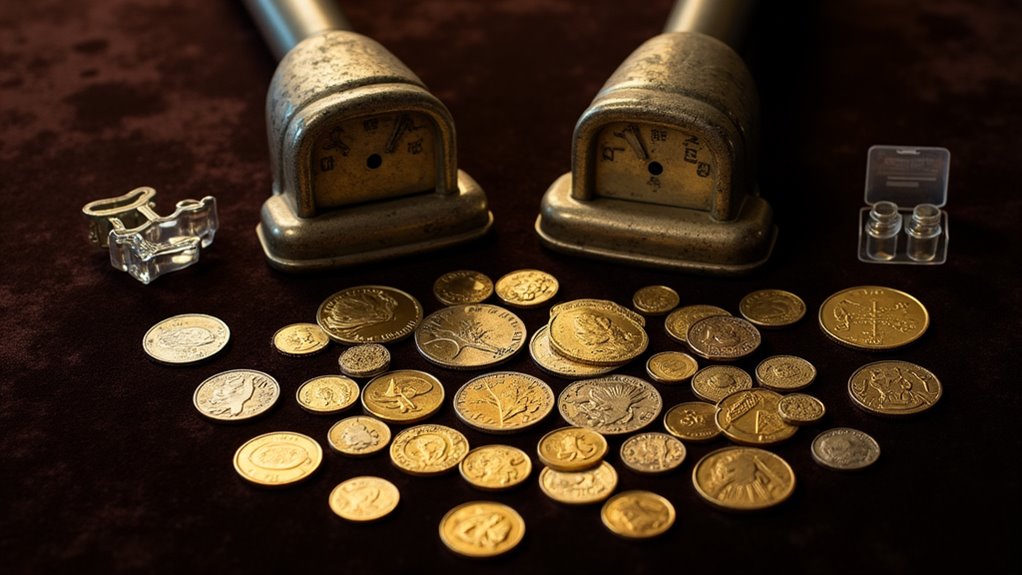
Gold reserve currency represents a monetary system where paper money is directly backed by physical gold holdings – talk about putting your money where your metal is! This setup dominated global finance for centuries, forcing governments to maintain actual gold reserves before printing cash. While most countries abandoned the gold standard by 1971, its legacy lives on through central banks’ continued gold stockpiling and its enduring role as a hedge against economic chaos. The glittering history of gold-backed money holds fascinating lessons for today’s financial world.

Money’s sexiest accessory has always been gold, and nowhere is this more evident than in the concept of gold reserve currency. This monetary system, which dominated global finance for centuries, linked paper currency directly to the alluring yellow metal, forcing governments to keep their printing presses in check and their gold vaults well-stocked.
Gold’s seductive power transformed global finance, turning the precious metal into history’s most trusted monetary chaperone.
The system’s heyday stretched across the 19th and early 20th centuries, when the British pound strutted its stuff as the world’s premier reserve currency. After World War II, the US dollar swooped in like a financial superhero, backed by Fort Knox’s massive gold stockpile. The 1944 Bretton Woods Agreement made it official – the dollar would be convertible to gold at $35 per ounce, making Uncle Sam’s currency the hottest thing since sliced bread in international finance. The U.S. economy was particularly dominant during this period, as it produced half of the world’s GDP. This dominance meant that fluctuations in the USD value directly impacted global gold prices, influencing investor behavior.
But here’s where it gets juicy: gold reserve currency acted like a financial chastity belt, preventing governments from getting too frisky with their money printing. Central banks had to maintain substantial gold reserves, ready to convert paper into precious metal at a moment’s notice. This created a rigid yet reliable system where currencies maintained relatively stable exchange rates, and international trade flourished like never before. The system’s origins can be traced back to when first gold coins were minted around 650 B.C. Furthermore, central banks recognized that the strategic importance of gold lies in its ability to serve as a hedge against inflation and currency fluctuations, which is why it remains a key component of many national reserves today. Interestingly, gold is now classified as a Tier 1 asset under Basel III, providing banks with a reliable way to meet capital requirements. Additionally, the Federal Reserve’s gold holdings have historically played a significant role in shaping U.S. monetary policy.

The system wasn’t without its quirks and hiccups though. During economic downturns, it could be about as flexible as a gold bar – which is to say, not at all. Countries found themselves trapped in deflationary spirals, unable to stimulate their economies because they couldn’t expand their money supply beyond their gold reserves. Talk about being caught between a rock and a golden hard place!
By 1971, most countries had thrown in the towel on the gold standard, finding its constraints too restrictive for modern economic management. Yet gold’s allure persists – central banks still hoard it like dragons guarding their treasure, treating it as an essential component of their foreign exchange reserves. During times of economic uncertainty, gold’s popularity soars faster than a rocket-powered bullion vault.
Today, while some economists pine for the return of the gold standard (bless their nostalgic hearts), most recognize that its time has passed. However, the lessons of gold reserve currency continue to influence monetary policy. The system demonstrated that backing currency with something tangible can inspire confidence and stability – even if that something happens to be a shiny metal we dig out of the ground.
Digital currencies may be the new kids on the block, but they’re still trying to solve the same old problem: how to create money that people trust. Meanwhile, gold sits in central bank vaults worldwide, smugly knowing it’s maintained its value for thousands of years. Maybe that’s why they call it the ultimate hedge – it’s been playing hard to get since before paper money was even a twinkle in a banker’s eye.
Frequently Asked Questions
How Does Gold Reserve Currency Affect International Trade Relationships?
Gold reserve currency greatly shapes international trade dynamics.
Countries with substantial gold holdings wield greater negotiating leverage and can better weather economic turbulence. It enables nations to settle trade deficits directly and promotes more balanced trading relationships.

The presence of gold-backed currencies historically reduced exchange rate volatility between trading partners, while also providing a reliable mechanism for international settlements and fostering stable long-term trade agreements.
What Happens to Gold Reserves During a Global Financial Crisis?
During global financial crises, central banks typically increase their gold reserves dramatically.
The 2008 meltdown sparked a massive shift – banks transformed from net sellers to aggressive buyers. When markets tank, gold becomes the ultimate safety blanket.
China and Russia lead the pack, stockpiling like there’s no tomorrow. Physical gold holdings surge as countries dodge currency risks and sanctions.

The yellow metal’s share in global reserves shoots up, reflecting that old-school trust in tangible assets.
Can Countries Refuse to Accept Gold as a Reserve Currency?
Yes, countries can absolutely refuse gold as a reserve currency.
In today’s fiat-driven world, there’s no international law forcing nations to accept or hold gold reserves. Since abandoning the gold standard, central banks have total autonomy over their reserve composition – whether that’s USD, euros, or even crypto (wild, right?!).
Sure, refusing gold might raise some eyebrows and affect trade relationships, but it’s totally within a nation’s sovereign rights to say “thanks, but no thanks” to the yellow metal.
How Often Do Central Banks Adjust Their Gold Reserve Holdings?

Central banks are constantly tweaking their gold reserves – it’s like they’re playing a never-ending game of portfolio Jenga!
Most adjustments happen quarterly or annually, but some banks get trigger-happy and trade monthly. The World Gold Council tracks these moves religiously, publishing data every quarter.
Recent years have seen a buying frenzy, with banks snatching up gold like its going outta style. China, India, and Poland have been particularly aggressive buyers lately.
Which Countries Hold the Largest Gold Reserves as Currency Backing?
The United States dominates global gold holdings with a massive 8,133.5 tonnes – that’s a whopping 77.5% of its foreign reserves!
Germany follows with 3,351.53 tonnes (66.7% of reserves), while Italy and France duke it out for third place, each hovering around 2,400 tonnes.

Russia rounds out the top 5 with 2,295.4 tonnes, though it’s only 22% of their reserves.
These powerhouse nations keep stacking the yellow metal like there’s no tomorrow!