Central banks worldwide are sitting on a massive 36,699 metric tons of gold – yeah, that’s a whopping 17% of all the yellow metal ever mined! The U.S. leads the pack with 8,133.46 tons, while Germany, Italy, and France round out the top spots. Recent buying sprees have been intense, with banks snatching up 1,037 tons in 2023 alone. These numbers only scratch the surface of this glittering global power play.

The shimmering fortress of central bank vaults worldwide now holds a staggering 36,699 metric tons of gold – enough to make King Midas blush. That’s roughly 17% of all the yellow metal ever yanked from Earth’s crust, and get this: most of it was snatched up in a 14-year buying spree since 2010. The world’s central bankers, those supposedly stoic guardians of monetary policy, have been loading up like kids in a candy store.
Uncle Sam still sits atop this golden throne with a whopping 8,133.46 metric tons, while Germany trails with 3,351.53 tons. Italy and France are practically neck-and-neck, hoarding 2,451.84 and 2,436.94 tons respectively. Russia‘s been playing catch-up, amassing 2,336 tons while thumb’n their nose at Western sanctions. The International Monetary Fund holds 2,814.1 tons, making it the third-largest holder globally. European nations have been increasingly focused on bringing gold home from foreign depositories to secure their wealth domestically. This push to maintain gold reserves reflects a broader strategy to enhance financial stability, as national gold reserves serve as a cornerstone for economic resilience, especially in light of recent inflationary pressures. Moreover, central banks view gold’s role in monetary policy as essential for maintaining trust in their currencies, with many seeing it as a tool for financial security in uncertain times.
2023 was a banner year for gold hoarding, with central banks stuffing another 1,037 tons into their vaults – the second straight year they’ve crossed the 1,000-ton threshold. And 2024? Already off to a roaring start with 290 tons added in Q1. Poland‘s leading the charge, grabbing 90 tons like it’s going out of style, while India’s been quietly padding its reserves with 73 tons.

These monetary maestros aren’t just collecting shiny paperweights – they’re playing a long game. Gold serves as their financial fortress during economic storms, a middle finger to inflation, and an emergency piggy bank when things go sideways. It’s basically their insurance policy against the world losing its marbles.
The logistics of storing all this bling would make Fort Knox jealous. The U.S. spreads its stash across Denver, Fort Knox, and West Point, while Germany plays it safe with vaults in Frankfurt, New York, London, and Paris. Italy’s got a similar strategy, splitting its hoard between home soil and foreign vaults. Even the Dutch are getting creative, stashing 38% in Canada, eh?
When these gold-wielding giants make moves, markets shudder. Remember when the U.S. dumped 1,280 tons in 2013? Gold prices took a nosedive faster than a lead balloon. But when Russia started golden up in 2014, prices shot through the roof. And don’t get us started on China’s sneaky acquisitions – they claim only 5% of their reserves are gold, but c’mon, who’s buying that?
Looking ahead, 70% of central bankers are planning to beef up their gold reserves in the next year. With the U.S. keeping over 75% of its foreign reserves in gold, and Germany sitting pretty with two-thirds, it’s clear these institutions aren’t about to lose their Midas touch anytime soon. The golden game of musical chairs continues, and nobody wants to be left standing when the music stops.
Frequently Asked Questions
Why Don’t Central Banks Sell Their Gold Reserves During Economic Crises?
Central banks keep their gold reserves during crises because selling would actually make things worse!

Gold acts as a financial stability anchor – dumping it could trigger panic and tank confidence in the whole system. Plus, it’s their ultimate insurance policy against currency chaos and political drama.
The yellow metal’s got staying power – just ask the 81% of central banks planning to buy more.
Smart move? You betcha!
How Do Central Banks Verify the Authenticity of Their Gold Holdings?
Central banks employ rigorous multi-layered authentication processes to verify their gold’s legitimacy.

They combine traditional physical tests (density, sound, visual) with cutting-edge tech like XRF spectrometry and ultrasonic scanning.
Regular audits by certified experts guarantee integrity, while sophisticated vault systems protect holdings.
Some banks even maintain detailed “chain of custody” records tracing each bar’s journey from mine to vault – cause ya can’t be too careful with billions in bullion!
What Security Measures Protect Central Bank Gold Storage Facilities?
Central bank gold storage facilities employ formidable multi-layered security measures.

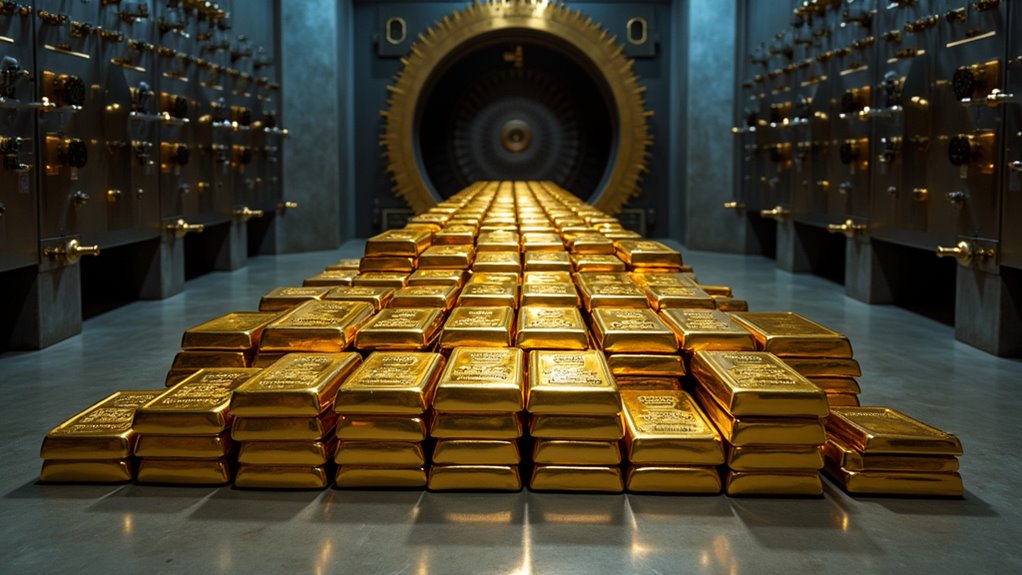
Their vaults feature bomb-proof construction with reinforced steel and concrete, plus multi-ton revolving doors.
High-tech systems include biometric scanners, infrared cameras, and motion detectors.
Armed guards with expert certification maintain 24/7 surveillance.
Time-locks and compartmentalized access guarantee no single person can compromise the facility.

Regular audits and robotic handling minimize human contact with stored bullion.
How Often Do Central Banks Conduct Physical Audits of Their Gold?
Central banks worldwide follow varied audit schedules, with most conducting physical gold checks every 5-10 years.
Some institutions, like Germany’s Bundesbank, are more rigorous with annual inspections, while others *cough* Fort Knox *cough* haven’t done a full count since 1953!
The timing often aligns with leadership changes or policy shifts.
It’s a wild mix – some banks proudly livestream their audits, while others keep their gold-counting habits under tight wraps.
Can Countries Borrow Gold From Other Central Banks in Emergencies?
Yes, countries can borrow gold from other central banks during emergencies through various mechanisms.
Central banks typically arrange bilateral gold swaps or seek assistance through institutions like the IMF and BIS. Notable examples include the UK’s gold borrowing from Germany in the 1970s and Mexico’s arrangement with the US in 1982.
However, such moves often signal economic distress, face political hurdles, and come with strict collateral requirements and legal restrictions.