The Federal Reserve’s relationship with gold took a dramatic turn in 1934 when the Gold Reserve Act stripped its ability to directly buy or sell bullion. Today’s Fed doesn’t own physical gold – shocking, right? – but holds certificates while acting as custodian for foreign governments and central banks. The New York Fed’s vault stores just 5% of U.S. Treasury gold, with the rest chillin’ at the U.S. Mint. Market impact? It’s mostly symbolic these days, but there’s more to this glittering tale.

Despite what shiny-obsessed goldbugs might believe, the Federal Reserve doesn’t actually own a single ounce of the yellow metal – and hasn’t since 1934, when the Gold Reserve Act forced the Fed to surrender its entire stash to the U.S. Treasury. Instead, the Fed received gold certificates denominated in dollars that, ironically, aren’t even redeemable for actual gold. Talk about a raw deal!
The relationship between the Fed and gold has been drastically altered since the heady days of the gold standard, when the central bank was required to maintain gold reserves equal to 40% of currency value. That all changed during the tumultuous spring of 1933, when Roosevelt’s administration began implementing restrictions on private gold ownership and usage. By October of that year, the government had launched an ambitious gold purchase plan that would fundamentally reshape America’s monetary system. The dramatic revaluation increased gold from twenty to thirty-five dollars per troy ounce. This historic shift was driven by strategic importance of gold as a reserve asset for the government. In the modern economic landscape, gold often serves as a hedge against rising interest rates that can diminish the appeal of other investments, reinforcing its role as a trust anchor in uncertain times. Additionally, gold’s unique properties make it a vital currency support tool for central banks seeking to bolster financial stability, as it provides a reliable hedge against inflationary pressures.
Roosevelt’s 1933 gold restrictions marked the end of an era when the Fed’s power was directly tied to its gold reserves.
The Federal Reserve Bank of New York’s massive vault currently stores gold for various foreign governments and central banks, plus about 5% of U.S. Treasury gold (valued at approximately $600 million at the statutory price of $42.2222 per ounce – yes, that’s the actual price they’ve used since 1973). The Federal Open Market Committee meets eight times annually to evaluate economic conditions and make crucial monetary policy decisions that can indirectly influence gold prices.

But don’t get any ideas about storing your personal collection there; the vault is strictly off-limits to private entities and individuals.
The Gold Reserve Act of 1934 didn’t just strip the Fed of its gold – it severely curtailed the central bank’s ability to conduct independent monetary policy. The Fed lost control over international fund flows and fundamentally became an implementer of Treasury policies rather than an autonomous policy-maker. This arrangement persisted until the Fed-Treasury Accord of 1951, which finally restored some of the Fed’s independence.
Today’s Federal Reserve serves primarily as a custodian for other’s gold, maintaining detailed records while providing storage services for various official account holders. The majority of U.S. Treasury gold (about 95%) is actually held by the U.S. Mint, not the Fed.
When it comes to market operations, the Fed doesn’t engage in gold purchases or sales for its own account – that ship sailed long ago.

The transformation from the gold standard era to our current system was nothing short of revolutionary. The Exchange Stabilization Fund, established with $2 billion under Treasury control, gave the government unprecedented power to conduct open-market operations without Fed approval.
This shift, combined with the prohibition on redeeming dollars for gold, effectively ended the classical gold standard in America.
For modern gold investors wondering about Fed intervention in precious metals markets, the reality is far less exciting than conspiracy theories might suggest. The Fed’s role is largely administrative, focused on custody services and maintaining those peculiar gold certificates that serve as a reminder of its former relationship with physical gold.
Any direct influence on gold markets comes from Treasury policy decisions, not Federal Reserve actions.
Frequently Asked Questions
How Does the Federal Reserve Store and Secure Its Gold Holdings?
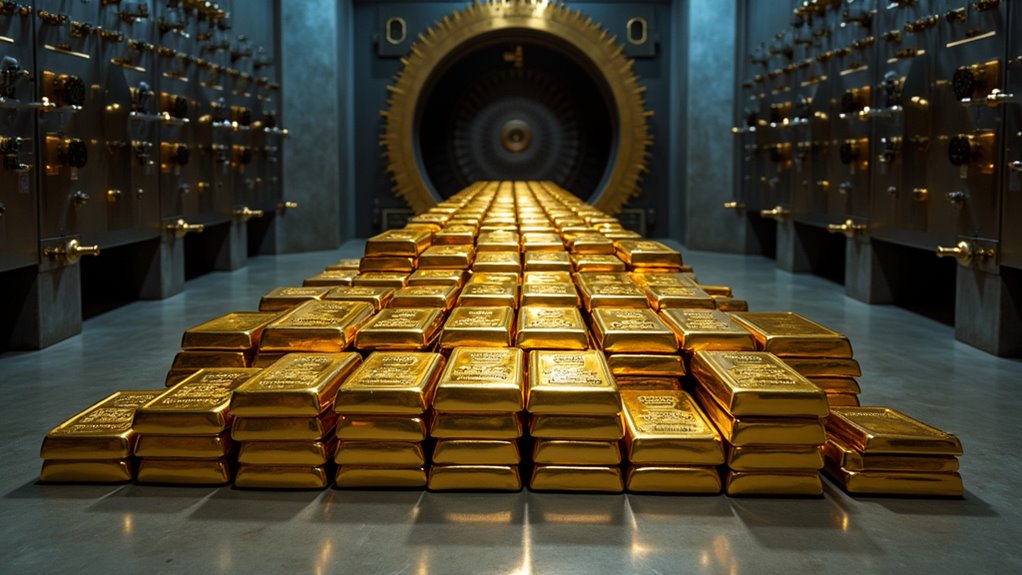
The Fed’s gold fortress lies 80 feet beneath NYC streets in an impregnable vault.
We’re talking 497,000 gold bars behind a 90-ton steel cylinder – talk about overkill!

Security’s insane: triple-locked compartments, 24/7 motion sensors, and a three-person rule where nobody knows all combinations.
Robotic systems handle the precious cargo at $1.75 per bar.
Fun fact: 98% ain’t even America’s gold – it’s foreign central banks’ stash!
Can Individual Investors Purchase Gold Directly From the Federal Reserve?
No way, folks – individual investors can’t buy gold directly from the Fed.
It’s a hard “nope” straight from the source. The Federal Reserve doesn’t own or sell physical gold to the public – that’s just not their thing!

Instead, enthusiastic gold bugs need to look elsewhere: U.S. Mint for those shiny coins, authorized dealers for bullion, or ETFs for paper exposure.
The Fed’s just a custodian, mainly holding Uncle Sam’s stash and some foreign gold.
What Happens to Federal Reserve Gold During Periods of Economic Crisis?
During economic crises, Federal Reserve gold typically faces dual pressures: internal and external drains.
Panicked citizens rush to convert paper money into physical gold (internal drain), while foreign investors, fearing currency instability, withdraw their gold deposits (external drain).

This happened dramatically in 1933, when the Fed’s “free gold” reserves got so depleted that the New York Fed couldn’t honor gold conversions – yikes!
The result? A national banking holiday and major policy shifts.
Does the Federal Reserve Lease or Loan Its Gold to Other Institutions?
While the Fed has authority to lease gold, they’re pretty tight-lipped about whether they actually do it.
Historical records show heavy gold leasing by central banks in the 1990s – we’re talking up to half their gold!
But today? It’s murky territory. The Fed can technically lease gold to bullion banks who’d pay interest, but they won’t confirm or deny current operations.
Classic Fed move, right? Keepin’ those gold dealings under wraps like Fort Knox secrets.
How Often Does the Federal Reserve Conduct Physical Audits of Its Gold?
The Federal Reserve conducts physical audits of its gold holdings annually through independent outside auditors.
While compartment-level inspections happen yearly, it’s worth noting the last full-blown exhaustive audit was done over 65 yrs ago – wild, right?!
Each vault gets the full treatment: padlocks checked, combination locks verified, and those mysterious numbered compartments sealed tight.
Treasury’s OIG also jumps in annually to audit those U.S. Gold Reserve schedules.