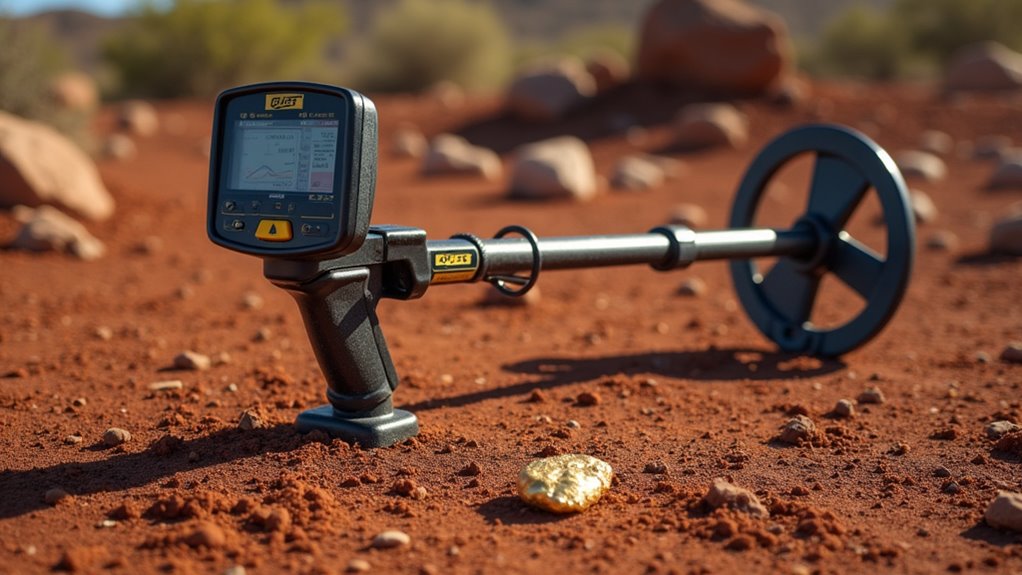
Gold ores aren’t created equal – some are stupidly easy to spot while others play hard to get.
Native gold flaunts its yellow metallic shine, quartz gold settles into veins like a secret stash, and sulfide ores hide their microscopic treasures like proper jerks.
Then there’s telluride ores, the fancy sports cars of the bunch, creating rich gold pockets.
Throw in placer and Carlin-type deposits, and you’ve got a wild spectrum of geological wealth begging to be understood.


Gold – the ultimate rockstar of the mineral world – comes in more flavours than your local ice cream shop. Let’s face it, this precious metal doesn’t just show up in one boring form.
Native gold, the purest of the pure, struts around in quartz veins like it owns the place, flashing its rich yellow colour and metallic shine. It’s ridiculously dense – up to 19.3 times heavier than water – and so soft you could practically scratch it with your fingernail. But hey, even the purest native gold has a few impurities hanging around, usually silver or copper, like uninvited guests at an exclusive party. With its high chemical stability, native gold naturally resists corrosion and most chemical reactions. An ounce of this remarkable metal can be stretched into a 35-mile wire without breaking.
Native gold swaggers through Earth’s crust like a superstar, flaunting its yellow brilliance while keeping a few silver and copper crashers in its entourage.
Speaking of parties, quartz gold ore is where things get interesting. This stuff forms in areas where tectonic plates threw a fit, creating perfect conditions for gold to settle into fractures and veins. Some high-grade deposits are absolutely loaded, packing up to 25% gold by mass. That’s like finding a quarter of your pay check hidden in your sock drawer – except way better.
Then there’s sulfide gold ore, the trickster of the bunch. It loves hanging out with pyrite (aka fool’s gold) and arsenopyrite, hiding microscopic gold particles that’ll drive miners bonkers.

Getting this stuff out requires some serious chemical wizardry involving flotation and cyanidation. Not exactly a backyard operation.
Telluride gold ores are the fancy pants of the gold world. These deposits form when gold hooks up with tellurium to create minerals with names that sound like exotic Italian sports cars – calaverite, sylvanite, and petzite. They’re notorious for forming incredibly rich pockets that make miners’ eyes pop out of their heads.
Let’s not forget placer deposits – nature’s own gold recycling program. Rivers and glaciers do all the hard work, eroding gold from primary sources and concentrating it into stream beds and alluvial fans. From tiny dust particles to chunky nuggets, this is the stuff that sparked gold rushes and still keeps prospectors up at night.
Carlin-type deposits are the quiet achievers of the gold world. They mightn’t look flashy, with their microscopic gold particles scattered through altered sedimentary rocks, but these low-grade deposits are absolutely massive. The Carlin mine in Nevada proves that sometimes the best things come in subtle packages.

And finally, there’s epithermal deposits, formed by ancient hot springs in volcanic areas. They’re typically smaller than other deposits but pack a serious punch when it comes to grade. These deposits are like finding a designer handbag at an op shop – small but incredibly valuable. They’re scattered across the globe, from Nevada to Australia, each with their own unique extraction challenges.
Frequently Asked Questions
What Tools and Equipment Are Needed for Basic Gold Ore Identification?
Let’s cut to the chase – you need the basics to spot gold ore.
Grab a decent hand lens and rock hammer for the heavy lifting.
Chuck in a gold testing kit with nitric acid to sort real gold from fool’s gold.
Add a UV light and specific gravity balance for good measure.
Don’t forget your safety gear – glasses and gloves are non-negotiable.
A GPS and sample bags‘ll round out your kit nicely.
How Do Environmental Regulations Affect Gold Ore Mining and Processing?
Environmental regs have hit gold mining hard – no more cowboys playing fast and loose.
The Clean Air Act‘s got miners watching their dust, while the Clean Water Act‘s turned water management into a bureaucratic nightmare.

Mercury limits are brutal – 1,460 pounds reduction yearly ain’t cheap.
Sure, it’s protecting Mother Nature, but it’s also jacking up costs and slowing everything down.
Miners are forced to adapt with fancy new tech or get shut down.
What Safety Precautions Should Be Taken When Handling Different Gold Ores?
Safety with gold ores isn’t a game – it’s life or death.
Different ores pack different punches: sulphide ores release toxic fumes, while arsenopyrite’s a proper nasty piece of work.
Miners better gear up with the right PPE – respirators, chemical-resistant gloves, and proper protective clothing are non-negotiable.
Regular air quality testing‘s essential, and proper ventilation’s a must.
No shortcuts here – one stuff-up with these minerals could be your last.
How Do Market Conditions Influence the Economic Viability of Gold Deposits?
Market conditions are brutal masters of gold mining’s fate. High gold prices make even low-grade deposits profitable, while price crashes can shut down operations faster than you can say “bankruptcy.”
Interest rates, currency values, and global chaos all push and pull on viability. Smart miners know the score – deposits that sparkle during booms might be worthless in busts.
It’s a ruthless numbers game where timing is everything.
What Role Does Modern Technology Play in Improving Gold Ore Recovery Rates?
Modern tech is revolutionising gold recovery – and it’s about bloody time. AI systems are cranking up plant performance by 10% while custom algorithms crunch complex geological data like it’s child’s play.
The real game-changer? Cyanide-free extraction hitting 84% recovery rates, leaving traditional methods in the dust at 64%. EnviroMetal’s formula is smashing records with 99.6% recovery in just 6 hours. Yeah, science!
The old ways are dead. Welcome to mining’s digital age.