The 1896 gold strike on Bonanza Creek ignited an explosion that birthed Dawson City overnight. Joseph Ladue staked out 65 hectares at the confluence of two mighty rivers, establishing a muddy outpost that morphed into a frontier powerhouse. As 100,000 prospectors raced north, the population soared past 30,000. Trading posts and saloons sprouted like weeds, transforming this slice of wilderness into a legendary boomtown. The real story of Dawson’s wild rise goes even deeper.

The glitter of hope struck like lightning in the Yukon Territory on August 16, 1896, when George Carmack, his wife Kate Carmack, and Skookum Jim made the discovery that would spark one of history’s most frenzied gold rushes. Their find on Bonanza Creek wasn’t just another false promise – this was the real deal, concentrated placer gold deposits that would transform a swampy wilderness into a legendary boomtown.
Gold fever ignited when three prospectors struck it rich at Bonanza Creek, transforming an untamed wilderness into the stuff of legend.
Enter Joseph Ladue, a savvy opportunist who recognized gold fever when he saw it. He quickly staked out 65 hectares where the Klondike and Yukon Rivers embraced, establishing what would become Dawson City. Named after geologist George Mercer Dawson, this muddy outpost exploded from literally nothing into a frontier metropolis, proving that sometimes the best business isn’t finding gold – it’s selling shovels to those who think they will.
The numbers tell a wild tale: roughly 100,000 prospectors dreamed big, but only 30,000 to 40,000 actually made it to Dawson. Reality hit harder than a pickaxe – just 4,000 struck any gold at all, and mere hundreds actually got rich. Meanwhile, Dawson’s population skyrocketed to somewhere between 30,000 and 50,000 souls, all crammed into a town that had been moose pasture just months earlier. The mining boom in Dawson City mirrored the investment prospects seen in other gold rushes around the world, with many miners engaging in open pit mining to extract gold from the surface. This surge in mining activity positioned Canada among the leading nations in gold production, further emphasizing its economic influence.

The gold rush wasn’t just about fortune-seekers though. The Tr’ondëk Hwëch’in First Nation, whose ancestral territory this was, found their world turned upside down as their traditional lands became a stampeding ground for gold-crazed newcomers. Some adapted by working as guides or miners, but the cultural impact was seismic and permanent.
Mining operations spread like wildfire across Bonanza, Eldorado, and Hunker Creeks. By July 1898, prospectors had staked roughly 10,000 claims, though many overlooked the rich deposits hiding in hilltops until late 1897.
Additionally, the rapid expansion of mining activities raised concerns about the environmental impact that would later prompt discussions on sustainable practices in the industry.
The boom created a commercial explosion in Dawson City, where trading posts and businesses sprouted faster than mushrooms after rain, serving everything from mining supplies to luxury goods for the newly rich.

But gold rush fever, like all fevers, eventually breaks. After 1899, Dawson City’s star began to fade as quickly as it had risen.
Still, the rush’s legacy echoed far beyond mere gold – it birthed the Yukon Territory itself in 1898, sparked global fascination through literature and media, and forever changed the region’s cultural landscape. The discovery that launched it all – that fateful day on Bonanza Creek – stands as a proof of how a single moment can transform a territory, birth a city, and capture the world’s imagination. Sometimes, it seems, lightning really does strike gold.
Frequently Asked Questions
What Tools and Equipment Did Early Yukon Gold Prospectors Typically Use?
Early Yukon prospectors relied on a no-nonsense toolkit that’d make modern miners jealous!
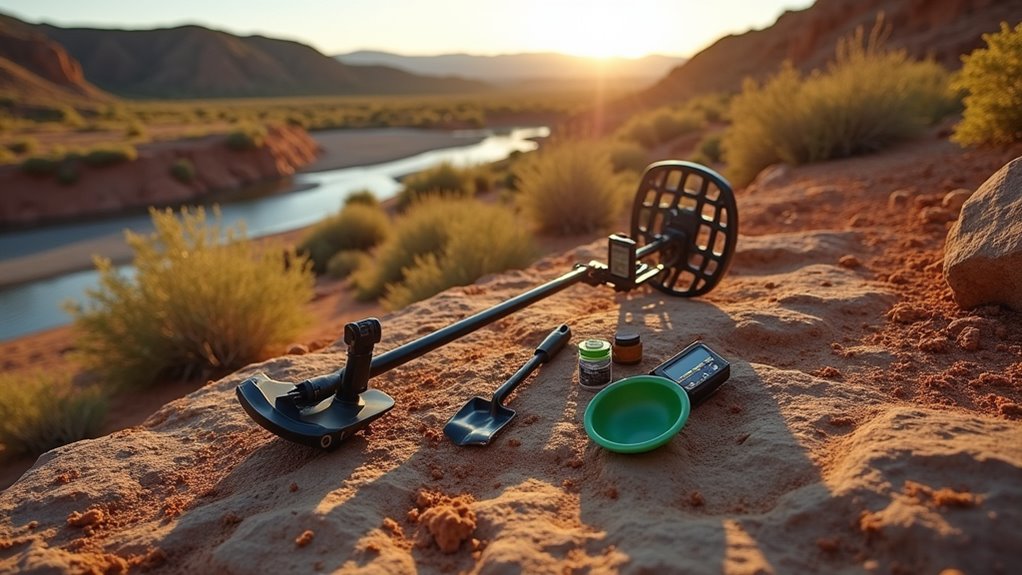
Their basic arsenal included trusty gold pans with riffles for trapping those elusive yellow flakes, classifiers for sifting out the junk, and the dynamic duo of shovel and pickaxe.

They’d also pack sluice boxes, snuffer bottles for nabbing tiny particles, and tweezers for the bigger nuggets.
Some savvy miners even lugged portable highbankers to boost their gold-catching game!
How Did Indigenous Peoples React to the Sudden Influx of Gold Miners?
Indigenous peoples faced devastating disruption when thousands of miners flooded their ancestral lands.
While some tribes initially engaged in trade and worked as guides, the gold rush ultimately shattered traditional ways of life.

Disease epidemics decimated populations, while environmental destruction wreaked havoc on hunting grounds.
Despite providing essential survival knowledge to miners, Indigenous communities were largely excluded from the wealth and pushed to society’s margins – a brutal transformation that echoed for generations.
What Was the Average Temperature During Winter Months in Dawson City?
Winter in Dawson City? Brrr, it’s a whole different ball game up there!
Daily highs hover between -15°C and -25°C during the brutal winter months of December thru February. January takes the prize for most bone-chilling, plunging to an average of -26°C.

But wait, there’s more – these temperatures occasionally nosedive below -45°C!
Compared to its southern cousin Whitehorse, Dawson City keeps it consistently 10 degrees colder. Talk about a gold-rush freeze!
How Did Prospectors Preserve and Transport Their Gold Findings?
Prospectors employed diverse methods to protect their precious finds. Rawhide pouches and leather bags were the go-to for storing gold nuggets, while canvas sacks proved perfect for larger hauls.
Smart miners buried their treasure underground in secret spots – can’t trust anyone during a gold rush!

For transport, they relied on backpacks, dog sleds, and even canoes. Armed convoys and night-time travel helped dodge those pesky bandits lurking in the wilderness.
What Happened to Failed Prospectors Who Couldn’t Afford to Leave Dawson City?
Failed prospectors faced brutal survival choices in Dawson City. Many took grueling $15/day labor jobs, but sky-high living costs ate their wages alive.
Some turned to hunting moose for meat sales, while others scraped by on half-rations during harsh winters. The desperate ones battled alcoholism and poverty, forced to endure until spring thaw.
A few integrated into the shrinking community, but most remained trapped in a cycle of bare subsistence – broke, cold, and disillusioned.