Recycled gold’s not just a feel-good eco story – it’s a $14.73 billion powerhouse that’s reshaping the precious metals landscape. The sector’s grown into a serious market force, claiming 28% of global supply and proving itself recession-proof. When gold prices jump 1%, recycling surges 0.6% – talk about a golden feedback loop! Better yet, it’s 300 times greener than mining, which explains why the industry’s projected to hit a staggering $27.3B by 2030. The real treasure lies in understanding what’s driving this explosive growth.

While gold mining continues to dominate headlines, recycled gold has quietly become the industry’s not-so-little secret, accounting for a whopping 28% of global supply over the past decade. According to the LBMA Spotlight report, recycling trends significantly influence bullion market dynamics. The numbers tell a story that’s impossible to ignore – the scrap gold recycling market ballooned from $13.5 billion in 2023 to $14.73 billion in 2024, and it’s not showing any signs of slowing down.
In fact, projections suggest this golden opportunity could hit a staggering $27.3 billion by 2030. The relationship between gold prices and recycling is fascinatingly predictable – for every 1% jump in gold prices, recycled supply inches up 0.6%. When gold prices soared from $58.72 per gram in January 2022 to $65.47 in January 2024, you better believe people were digging through their jewelry boxes. Major brands like Pandora are capitalizing on this trend by launching exclusive recycled gold collections.
Every uptick in gold prices sends people rushing to cash in, turning forgotten jewelry into cold, hard cash.
It’s like clockwork, folks – when the economy takes a nosedive, recycling takes flight. Remember the 2008 financial crisis? Cash4Gold.com became everyone’s best friend (until it wasn’t). The company rode the wave of desperate sellers right into bankruptcy by 2012 when the economy improved. Talk about a boom-and-bust cycle!

Even in India, a 1% uptick in unemployment triggers a 1.3% surge in global recycled gold – proving that economic hardship and gold recycling are practically dancing partners. Additionally, the challenges of collection inefficiencies in the recycling process can hinder the industry’s growth potential. The environmental angle is where things get really interesting. Recycling gold is 300 times more eco-friendly than mining – no bulldozers tearing up pristine landscapes, no toxic chemicals seeping into groundwater.
High-value recycled gold, mostly from jewelry, dominates the scene at 90% of total recycled supply. The remaining 10% comes from industrial sources, doubled from just 5% a decade ago – thank you, electronic waste! But it’s not all glitter and gold in the recycling world. Overcapacity is giving industry players headaches, and while industrial waste volumes are growing at 6% annually, recyclers can only get their hands on about 2% of what’s out there.
Still, the sector’s shown remarkable resilience – just look at 2009’s record-breaking 1,728 metric tons of recycled gold, representing a whopping 42% of total supply. The future’s looking bright (and shiny) for recycled gold, with a projected CAGR of 9.4% through 2028.
Sure, there are challenges, but innovations in extraction methods keep opening new doors. Whether driven by economic necessity or environmental consciousness, recycled gold has carved out its own precious niche in the market. And with the industry’s value expected to hit $21.1 billion by 2028, it’s clear this isn’t just some flash in the pan – it’s a golden opportunity that’s here to stay.
Frequently Asked Questions
How Long Does It Take to Refine Recycled Gold?
Refining recycled gold isn’t some quick-and-dirty process – it’s a serious time commitment.
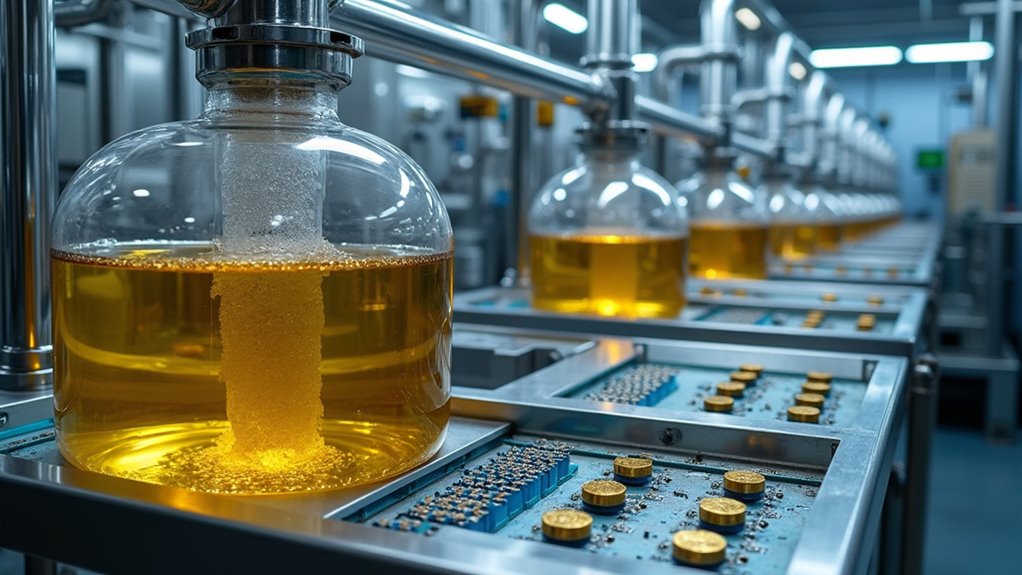
The whole shebang typically takes 12-16 hours from start to finish. First up, there’s 2-3 hours of pre-melt and chlorination action, followed by the main event: electrodeposition, which runs 8-12 hours.

Final steps? Just minutes. But hey, timing can swing wildly depending on initial purity, volume, and whether that gold’s playing nice with other metals.
Can Recycled Gold Jewelry Be Traced Back to Its Original Source?
Tracing recycled gold to its original source is typically a wild goose chase.
Once melted and refined, gold loses its fingerprint – it’s like trying to trace a drop of water in the ocean!
While blockchain and nano-marking technologies offer some hope, most recycled gold’s origins remain murky at best.

The industry’s mixing of sources and multiple refining cycles make complete traceability nearly impossible.
Some certification systems help, but they’re more about process than precise origins.
Does Recycled Gold Tarnish More Easily Than Newly Mined Gold?
Recycled gold absolutely does not tarnish more easily than newly mined gold.
Here’s the deal: once refined, recycled gold is molecularly identical to fresh-outta-the-ground gold.
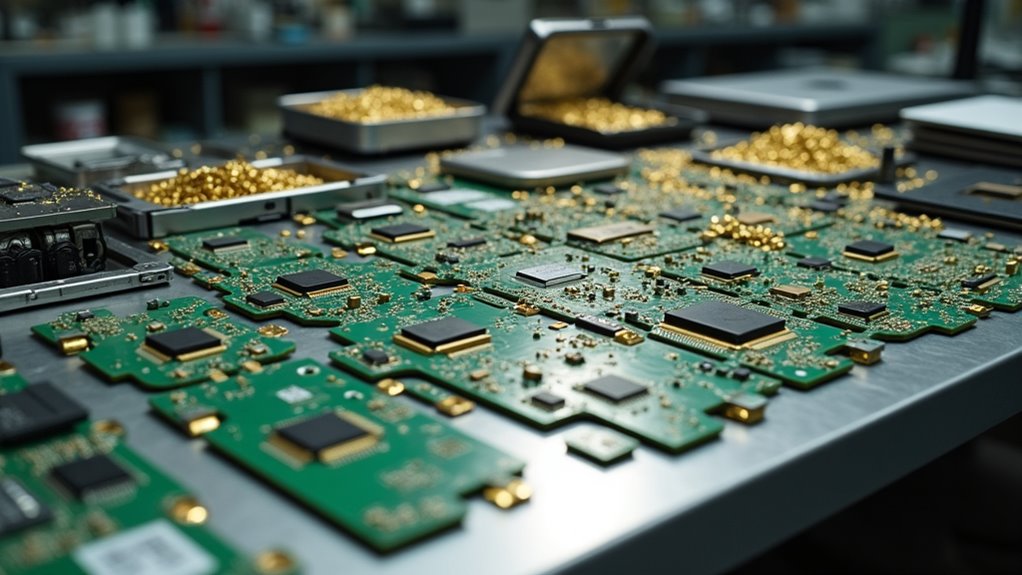
Both undergo the same rigorous purification process, resulting in chemically indistinguishable materials.
Any tarnishing issues stem from factors like karat purity, skin chemistry, or environmental exposure – not whether the gold’s been recycled.
The source simply doesn’t affect tarnish resistance, period.
Which Countries Are the Largest Importers of Recycled Gold?
Belgium dominates the recycled gold game, crushing it with a whopping 123,000+ metric tons in 2023.
Germany’s not far behind, pulling in 80,000+ tons.

Looking at 2022’s numbers, Canada flexed with $2.58B worth, while Switzerland and Spain rounded out the top spots with $1.91B and $1.24B respectively.
These powerhouse nations are basically running the show in the recycled gold market – and that’s just how it is! *mic drop*
What Percentage of Gold Jewelry Sold Worldwide Contains Recycled Gold?
The exact percentage of recycled gold in worldwide jewelry sales remains frustratingly elusive – there’s no thorough global tracking system!
While major players like Pandora are going all-in with 100% recycled gold, most manufacturers use a mix of new and recycled materials.
Industry estimates suggest recycled gold makes up roughly 25-30% of jewelry production, but these numbers fluctuate wildly by region and economic conditions.
It’s basically a gold-plated guessing game!