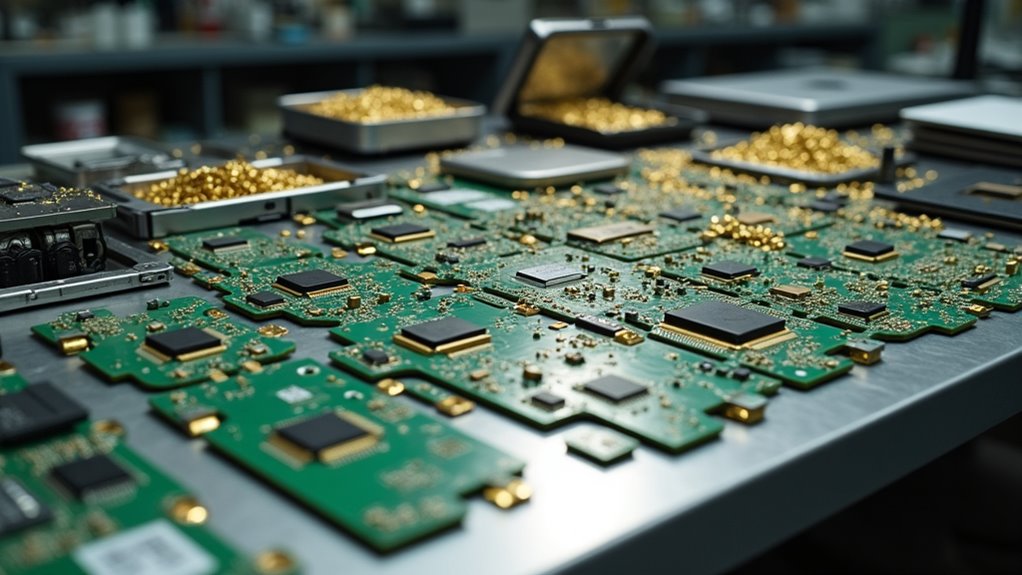

Urban mining is turning our mountains of e-waste into literal goldmines. A single ton of discarded electronics contains 300-400g of gold – that’s 10x richer than natural ore deposits! The global e-waste market’s sitting pretty at $91 billion, but we’re only recovering 20% of that treasure. While traditional mining spews 52 million tons of greenhouse gasses, urban mining‘s becoming the smart play. The kicker? Those 150 million phones Americans trash yearly are packed with untapped riches.

Nearly every smartphone we toss contains more gold than a ton of raw ore – and that’s not even the craziest part of urban mining. This revolutionary approach to resource extraction is turning our trash heaps into literal goldmines, and the numbers are absolutely bonkers. We’re talking about 300-400 grams of gold per ton of e-waste – that’s 10 times more concentrated than what you’d find in natural deposits. Holy circuit boards, Batman! The process helps conserve natural resources through systematic recovery of valuable materials.
The global e-waste market is sitting on a $91 billion metal jackpot, and we’re only scratching the surface with a measly 20% recovery rate. It’s like watching someone throw away winning lottery tickets, except these tickets are killing our planet. Traditional mining operations are spewing out 52 million tons of greenhouse gases while wreaking havoc on pristine landscapes – meanwhile, we’ve got mountains of discarded electronics just begging to be processed. In the United States alone, 150 million mobile phones are discarded every year.
Trashing smartphones isn’t just wasteful – it’s like burning money while the planet chokes on mining’s toxic legacy.
But here’s where things get tricky (and a bit messy). Getting that precious gold out of your old iPhone isn’t exactly a walk in the park. These devices are cocktails of hazardous materials mixed with valuable metals, and separating them requires some serious technological muscle. We’re talking about grinding PCBs into powder, releasing gold-hungry bacteria, and zapping metals with electricity until they behave. It’s basically mad science meets recycling. The challenges of collection inefficiencies in gold recycling can complicate the process even further.

The economic implications are staggering, and not just because of the gold. Urban mining is creating jobs faster than you can say “circular economy,” while reducing our dependence on politically volatile supply chains. Plus, there’s a whole treasure trove of other goodies in there – copper, silver, palladium – it’s like a periodic table party in every discarded laptop.
The future’s looking pretty shiny for urban mining, despite some major hurdles. Sure, the extraction costs are high, and some critical elements are still playing hard to get with sub-1% recovery rates. But innovation‘s charging ahead like a bull in a china shop. Research facilities are popping up worldwide, and waste management strategies are getting smarter by the minute. The green tech revolution is driving demand through the roof, making every discarded device more valuable than the last.
Let’s face it – we’re sitting on an urban gold mine that makes traditional prospecting look like searching for pennies in couch cushions. While the challenges are real (and sometimes downright dangerous), the potential rewards are too massive to ignore. As technology improves and awareness grows, urban mining isn’t just becoming viable – it’s becoming inevitable. And that’s something worth getting excited about, even if you’re not a gold bug.
Frequently Asked Questions
How Long Does It Take to Extract Gold From Electronic Waste?
The gold extraction timeline from e-waste varies dramatically!
Traditional methods take 24-48 hours, with each phase demanding its own sweet time – from initial crushing (1-2 hrs) to that nail-biting final refining (4-8 hrs).

But hold onto your circuits, because newer tech‘s changing the game. Microwave-assisted leaching slashes it to 1-2 hours, while bioleaching’s eco-friendly approach stretches to 3-7 days.
Efficiency depends on volume, tech used, and required purity.
What Safety Equipment Is Required for Urban Mining at Home?
Urban mining at home requires serious safety gear – no cutting corners here!
Essential equipment includes chemical-resistant gloves, safety goggles, and a proper respirator (not just a dust mask!). A well-ventilated workspace with fume extraction is non-negotiable.

You’ll need a fire extinguisher, spill containment kit, and first aid supplies nearby. Don’t forget protective clothing and steel-toed boots.
Most importantly: an eyewash station for those “oops” moments with nasty chemicals.
Which Countries Have the Highest Success Rates in Urban Mining?
Japan and Belgium dominate the urban mining scene with jaw-dropping success rates.
Japan’s sitting on 16.4% of global gold deposits through e-waste – that’s insane!

Belgium’s Umicore plant is crushing it, pulling 28% of their revenue from urban mining.
South Korea’s catching up fast with their battery recycling tech (only 3 countries can do it!).
These powerhouses have mastered extracting precious metals from our electronic junk like nobody’s business.
Can Urban Mining Be Profitable for Small-Scale Individual Operators?
Small-scale urban mining faces major profitability hurdles.
While e-waste‘s gold content (1120 g/t) looks tempting, the reality’s less shiny. Most operators struggle with inadequate equipment, health hazards, and legal gray zones.

The $150 monthly income seen in Tanzania shows it’s barely sustainable. Without proper facilities and capital, individual operators often resort to dangerous extraction methods that yield minimal returns.
Large-scale operations dominate the profitable segments of this market.
What Are the Legal Requirements for Starting an Urban Mining Business?
Starting an urban mining business requires extensive regulatory compliance. Operators must obtain permits for handling hazardous materials, secure environmental licenses, and register with protection agencies.
OSHA workplace standards are mandatory, along with proper PPE and safety training. The biggie? Following RCRA guidelines for waste management.

Local zoning laws and business permits are essential too. International operators face additional hurdles like Basel Convention compliance – it’s a bureaucratic maze!