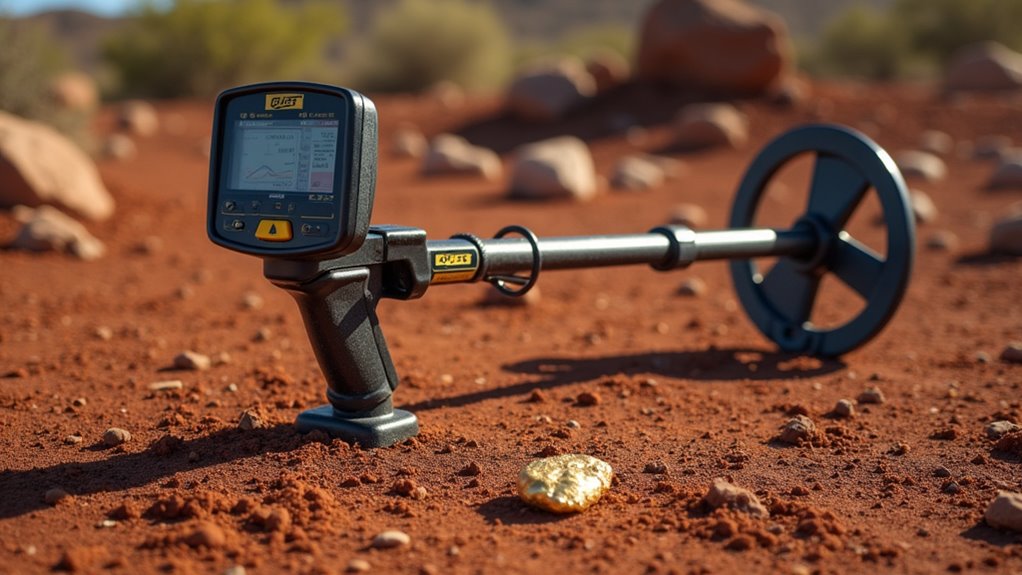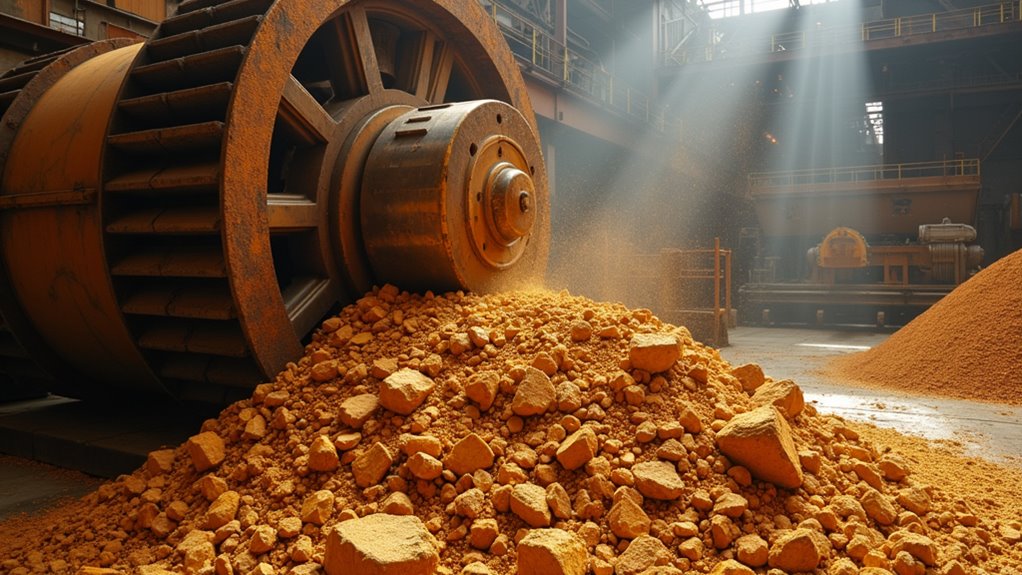

Crushers and grinding mills form the backbone of modern gold mining’s size reduction process. Jaw crushers start the show, chomping massive boulders into fist-sized chunks like mechanical T-Rexes gone wild. Secondary cone crushers take over, followed by ball mills that pulverize ore into a fine powder – think coffee grinder on steroids. This brutal yet precise crushing sequence transforms stubborn rock into particles small enough for gold extraction. There’s more to this metal-munching madness than meets the eye.

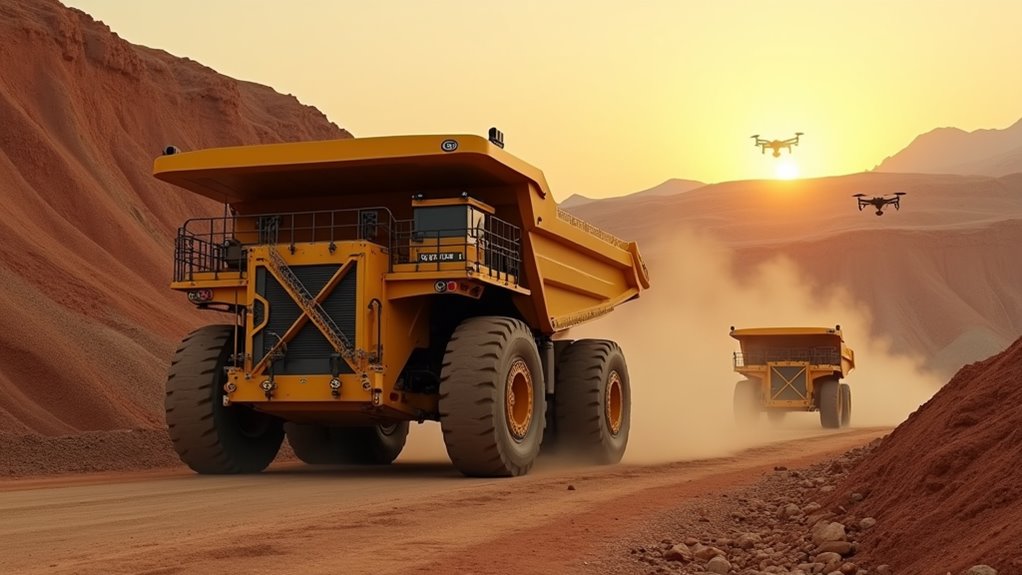
The thunderous roar of crushing machinery echoes across modern gold mining operations, where an impressive arsenal of specialized equipment transforms raw ore into gleaming bullion. At the heart of this transformation lies a brutal yet precise sequence of crushing and grinding steps, each designed to progressively reduce massive chunks of gold-bearing rock into manageable particles. Gold ores can be classified into various types such as free-milling and refractory ores, each requiring specific treatment methods. Gold mining techniques have evolved over the years to enhance efficiency and recovery rates, including the integration of automation technology that streamlines the entire process.
The process kicks off with jaw crushers, these beast-like machines that literally eat rocks for breakfast. They’re the primary crushers, chomping down on hard rock ore with their massive steel jaws, reducing boulders to rocks about the size of your fist. It’s not exactly delicate work – more like watching a mechanical T-Rex devour its prey. The manual or motorized versions offer different crushing capacities depending on the operation’s scale. The open pit method often yields higher volumes of material, making these crushers essential for larger operations. Understanding the importance of mining permits ensures that operations remain compliant with local regulations.
Jaw crushers rip through rock like prehistoric beasts, transforming massive boulders into fist-sized chunks with their relentless steel teeth.
The crushed material then gets fed into secondary crushers, typically cone crushers, which further reduce the ore size using an eccentric rotating motion that’d make any disco dancer jealous. Advanced wet processing techniques are integrated to enhance the efficiency of the crushing operation.

But here’s where things get really interesting – the grinding circuit takes over. Ball mills, fundamentally giant rotating drums filled with steel balls, tumble the crushed ore into submission. These mills are like cosmic washing machines on steroids, turning rocks into powder through constant impact and abrasion.
SAG mills take this concept even further, using larger steel balls and letting the ore itself help with the grinding – talk about making rocks do the heavy lifting!
The choice between different types of crushing and grinding equipment isn’t just a game of eeny, meeny, miny, moe. Miners gotta consider the ore’s hardness, desired throughput, and economic factors. Sometimes they’ll throw impact crushers into the mix for softer ores, or maybe add a gyratory crusher if they’re dealing with massive volumes.
Rod mills might get their moment to shine in intermediate grinding stages, working alongside ball mills like a well-choreographed industrial ballet.

The whole system operates in closed circuits with screening equipment that constantly checks particle size. Think of it as a bouncer at an exclusive club – if the particles aren’t small enough, they get sent back for another round of grinding.
Hydrocyclones join the party too, using centrifugal force to separate fine particles from coarse ones in wet grinding circuits. It’s basically a high-tech tornado in a cone.
The end result of all this crushing and grinding? Ore particles fine enough to liberate the precious gold trapped within the rock matrix. Without this vital size reduction, subsequent processing steps like leaching or gravity concentration would be about as effective as trying to squeeze juice from whole oranges without cutting them first.
And that’s the not-so-simple story of how massive rocks become gold-bearing powder – one crush, one grind at a time.
Frequently Asked Questions
What Safety Certifications Are Required to Operate Crushing Equipment in Gold Mining?
Operators must complete MSHA’s mandatory 24-hour new miner training or 8-hour annual refresher for experienced miners.
Equipment-specific certifications are essential – no exceptions.

Fall protection and lockout/tagout credentials? Absolutely required.
Crushing equipment operators need task-specific qualifications plus basic first aid/CPR.
Some jurisdictions demand additional local permits.
CMSP certification isn’t mandatory but definitely boosts career prospects (whoops on that apostrophe!).
How Often Should Crushing and Grinding Equipment Undergo Maintenance Inspections?

Regular maintenance is crucial for crushing and grinding equipment.
Daily checks focus on basic lubrication, feed inspection, and monitoring for unusual noises.
Weekly inspections involve tightening connections and clearing blockages.
Monthly maintenance requires wear part replacements and thorough cleaning.

Annual overhauls demand complete disassembly, replacement of critical components, and exhaustive testing.
This tiered approach helps prevent costly breakdowns and guarantees peak performance.
What Are the Environmental Impacts of Using Crushers in Gold Mining?
Crushers in gold mining create significant environmental havoc. The equipment generates toxic dust clouds containing heavy metals that contaminate surrounding soil and water.
Constant crushing operations produce deafening noise pollution disrupting local wildlife. The process requires massive energy consumption, contributing to greenhouse gas emissions.

Ground vibrations from crushers can destabilize nearby terrain, while soil erosion accelerates due to extensive material handling and stockpiling.
It’s an environmental triple-whammy – air, noise, and land impacts.
Which Countries Are the Largest Manufacturers of Gold Mining Crushing Equipment?
China dominates the gold crusher manufacturing scene, snagging over 40% of global market share – no surprise there!
The U.S. brings serious muscle with Caterpillar and Terex leading the charge, while Germany’s engineering prowess shows through ThyssenKrupp’s precision machines.
Japan’s right up there too – Komatsu and Hitachi are crushing it (pun intended!) in the tech department.
These four powerhouses practically own the mining equipment game, folks.
How Much Does It Cost to Replace Worn-Out Parts in Grinding Mills?
Replacing worn-out parts in grinding mills is a serious cost-driver!
Annual maintenance typically runs 30-40% of total operating expenses, with parts replacement eating up a huge chunk.
We’re talking $50,000-$200,000 per major component – liners alone can cost upwards of $100k.
Here’s the kicker: grinding media (those metal balls?) They’ll set you back $1-2 per kg, and mills devour tonnes of ’em annually.
Ouch!
Bearings and drive components? Another $30k-80k hit.