Selecting the right gold mining crusher boils down to hard science and cold numbers. Key factors like rock hardness, moisture levels, and desired output size determine whether a jaw, cone, impact, or gyratory crusher fits the bill. Jaw crushers handle tough, abrasive rocks up to 1200mm, while impact crushers excel with softer materials – each type has its sweet spot. Smart miners match specs to operational needs, avoiding the profitablity-killing mistake of wrong equipment choice. There’s more beneath the surface of crusher selection.

When it comes to crushing gold-bearing ore, choosing the wrong equipment can absolutely destroy your mining operation’s profitability – and we mean that literally. The key to success lies in matching your crusher to your specific operational needs, and boy, there’s a lot to reflect upon. From the rock’s hardness to moisture content, from desired output size to whether you need to move the darn thing around – every factor matters in this high-stakes game. Understanding the ore’s humidity level requirements is critical for maximizing productivity and preventing equipment failures. Additionally, the choice between open pit and underground mining can influence the types of crushers best suited for your operation. Furthermore, ensuring compliance with local and international regulations is essential for legal mining operations, especially in regions where gold mining regulations can vary significantly. In fact, selecting the right equipment can greatly enhance operational efficiency, leading to improved overall outcomes. Using the right placer mining equipment can also significantly improve recovery rates, making it a vital consideration.
Let’s get real – jaw crushers are the workhorses of the industry, handling those tough-as-nails, abrasive rocks like they’re having breakfast. With feed sizes up to 1200mm and capacities hitting 600 tons per hour, they’re reliable beasts that won’t break the bank on maintenance. Plus, they’re perfect for both stationary and mobile setups, which is pretty sweet if you’re running a smaller operation. Regular lubrication tasks are essential for maintaining optimal jaw crusher performance.
But maybe you’re looking for something with a bit more finesse? That’s where cone crushers strut their stuff. These bad boys excel at secondary and tertiary crushing, producing more uniform products than their jaw-crushing cousins. With reduction ratios that’ll make your head spin and capacities exceeding 1000 tons per hour, they’re the go-to choice for medium to hard rock processing. Just don’t expect them to be as forgiving as jaw crushers when it comes to maintenance.

Impact crushers? Now we’re talking about the speed demons of the crushing world. With reduction ratios up to 40:1, they’ll turn your ore into beautifully cubical products faster than you can say “gold rush.” But here’s the catch – they’re like temperamental artists, performing brilliantly with softer materials but throwing a fit when faced with super hard, abrasive ores.
For those dreaming big (really big), gyratory crushers are the heavy-weight champions. These monsters handle the highest capacities in primary crushing, with feed openings up to 1600mm. They’re perfect for hard, abrasive ores and never take a break thanks to their continuous crushing action. But let’s be honest – unless you’re running a major mining operation, this might be overkill.
The final decision comes down to cold, hard specs: crusher feed opening size, closed-side setting, product size range, power requirements, and maintenance needs.
And don’t forget about mobility – whether you need a fixed plant or something that can chase the gold wherever it leads. Remember, the perfect crusher balances your material characteristics, production goals, and operational constraints. Choose wisely, because in this game, the wrong choice isn’t just expensive – it’s potentially catastrophic for your bottom line.
Frequently Asked Questions
What Safety Certifications Should I Look for in a Gold Mining Crusher?
Essential safety certs for gold crushers include OSHA’s 30-Hour Construction and MSHA’s Part 46 New Miner Training – no compromise there!

The machine itself better have manufacturer-specific safety documentation and UL/CSA certifications.
Pro tip: ISO 45001 certification‘s a major bonus. Operators need those First Aid/CPR cards too.
Heck, even European CE marking matters if you’re running serious equipment.
Safety first, gold rush second!
Can I Rent a Rock Crusher Before Committing to Purchase?
Renting crushers is a savvy way to test-drive before dropping serious cash.

Most equipment dealers offer weekly or monthly rentals, complete with delivery and basic training. It’s perfect for getting hands-on experience with different models – jaw crushers start around $1,000/week, while fancier cone crushers might run $2,500+.
Pro tip: Some companys even offer rent-to-own options, letting miners apply rental payments toward eventual purchase. Smart move for commitment-phobes!
How Often Should Maintenance Be Performed on a Gold Mining Crusher?
Rock crushers demand relentless attention – daily visual checks and lubrication are non-negotiable.
Weekly inspections dig deeper, focusing on wear parts and belt tensions.
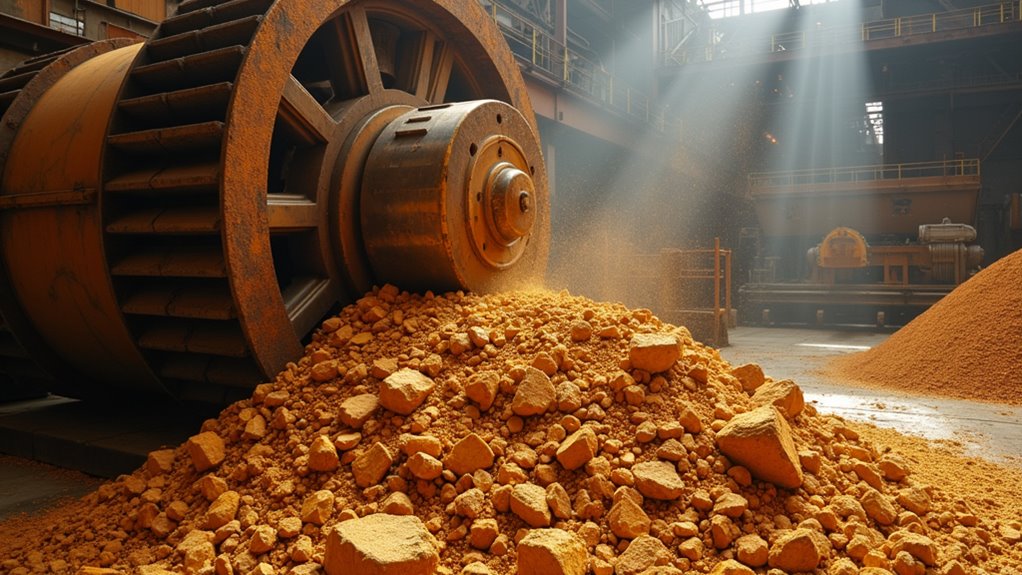
Monthly maintenance (sic) gets serious with thorough mechanical checks and component replacements.
The big kahuna? Annual teardowns – complete disassembly and rebuild of major parts.
Skip these schedules and watch your crusher turn into an expensive paperweight!
It’s like babysitting a metal-eating monster.
What Noise Levels Are Considered Acceptable for Residential Gold Mining Operations?
For residential gold mining, WHO guidelines specify 55 dBA during daytime and 45 dBA during nighttime as acceptable levels.

Noise shouldn’t increase background levels by more than 3 dB at nearby homes.
However, mining activities typically generate 90+ dBA, making residential operations challenging.
Local regulations may be stricter – some jurisdictions completely prohibit mining in residential zones.
Careful noise management and community engagement are essential for compliance.
Are There Specific Permits Required for Operating a Rock Crusher?
Operating a rock crusher requires serious permit game. Air quality permits are mandatory in most states – no exceptions.

You’ll need either a General or Site-Specific Permit before crushing a single rock. Environmental agencies (like TCEQ or EGLE) handle the bureaucratic dance.
The process? Application, review, approval – the whole enchilada.
Don’t even think about firing up that crusher without proper paperwork, or you’ll be crushed by fines!