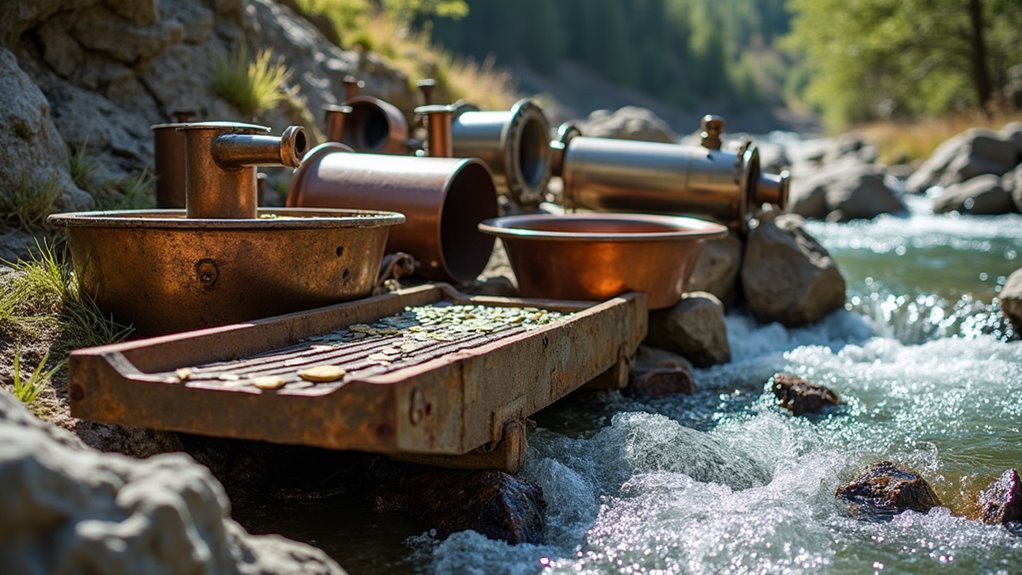
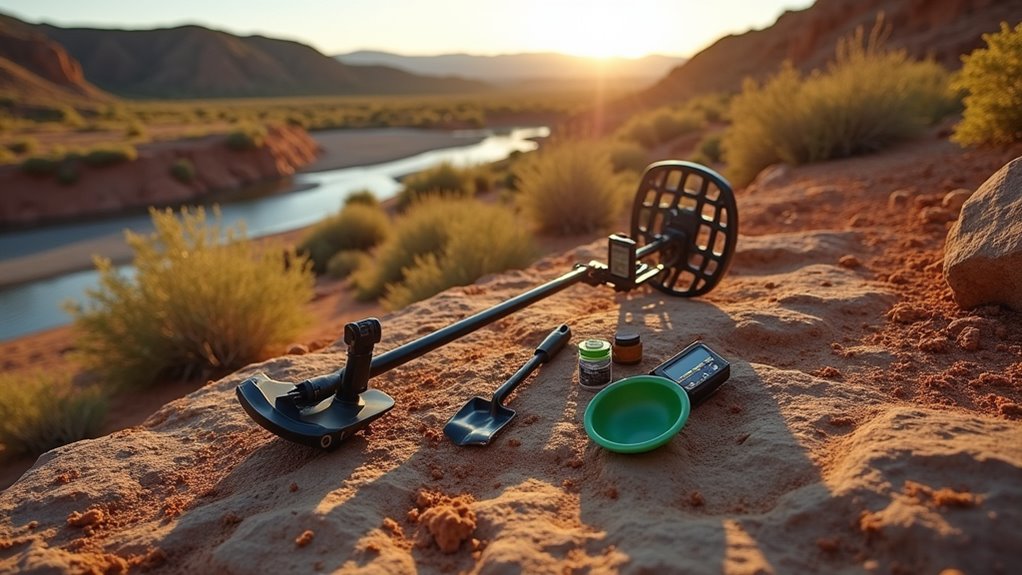
From basic gold pans to heavy-duty wash plants, placer mining equipment comes in all sizes and capabilities. Small-scale prospectors rely on trusty 15-inch pans and portable sluice boxes with clever riffle designs. Stepping up? Rocker boxes and long toms boost processing power without breaking the bank. For serious operators, trommels and modern centrifugal concentrators handle up to 150 tonnes per hour, capturing even microscopic gold. The deeper you go into these golden tools, the more treasure awaits.

The glitter of gold has driven prospectors to devise increasingly clever ways of separating precious metal from worthless dirt. The journey from basic tools to sophisticated machinery reveals humanity’s relentless pursuit of that yellow metal we’re all obsessed with. Let’s face it – some of these contraptions are pure genius, while others are just glorified dirt-sifters. High density minerals naturally sink faster than lighter materials, making separation possible. In the world of mining, open pit mining often contrasts with underground methods, each having unique advantages.
Traditional gold pans and sluice boxes remain the go-to choice for broke prospectors and weekend warriors. These 15-18 inch pans might look simple, but they’ve pulled millions in gold from streams worldwide. Sluice boxes, with their clever riffle design, trap those sneaky sub-millimeter particles that would otherwise slip away. They’re cheap, portable, and they actually work – what’s not to love? The advanced VIBRATING SLUICE BOX processes can achieve impressive recovery rates between 70-74% through two stages of operation. Additionally, gold pans are often praised for their ability to allow prospectors to test new areas quickly. This versatility is key for determining the potential mineral deposits in any given location.
When you’re ready to step up your game, rocker boxes and long toms enter the picture. These bad boys process more gravel per day than your arms could ever handle with a pan. They’re perfect for those moderately rich deposits where water’s scarce and you’re not trying to move mountains. Think of them as the Toyota Corolla of placer mining – reliable, practical, and gets the job done without breaking the bank.

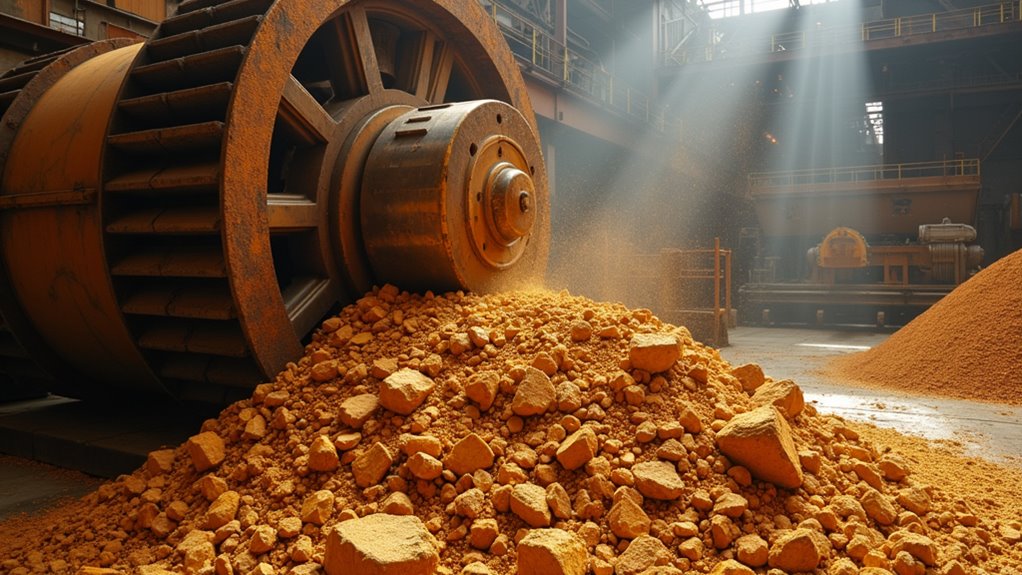
Now we’re talking serious business with trommels and wash plants. These rotating beasts can handle anywhere from 1 to 400 tonnes per hour, depending on how much cash you’re willing to throw at them. They’re basically the bouncers of the mining world, filtering out those annoying boulders that keep crashing your gold-recovery party.
Since 1914, jigs have been helping miners capture more gold, but modern centrifugal concentrators are the new hotness. The Falcon Concentrator cranks up to 150 tonnes per hour, generating forces up to 200 times gravity. It’s like putting your gold-bearing material through a carnival ride from hell – and somehow, it works brilliantly.
Hydraulic mining equipment brings the big guns – literally. These water cannons blast apart sediments like nature’s pressure washer, though environmentalists tend to get a bit touchy about the whole thing (can’t imagine why).
Meanwhile, dredges and excavators float around or crawl through deposits, processing material like hungry metal monsters.

For those really finicky deposits with microscopic gold particles, advanced gravity separation techniques come into play. Multi-gravity separators and enhanced concentrators handle those sub-50 micron particles that used to drive miners absolutely bonkers. It’s like having a microscopic bouncer that only lets the good stuff through.
The evolution of placer mining equipment proves one thing – where there’s gold, there’s an engineer somewhere figuring out how to get it. Whether you’re panning in a creek or running a massive wash plant, the principles haven’t changed much – it’s still about separating the precious from the worthless, just with increasingly clever tools.
Frequently Asked Questions
What Permits Do I Need Before Starting Placer Mining Operations?
Placer miners need a stack of permits before striking gold – no shortcuts here!
Federal requirements include Section 404 Clean Water permits, NPDES coverage, and endangered species consultations.

State-level paperwork demands water pollution control, reclamation permits (for 5+ acres), and water rights.
Don’t forget local jurisdiction hoops: zoning permits, grading authorizations, and building permits.
Plus, BLM claim registration and financial bonding are absolutely essential.
Better get crackin’ on that paperwork!
How Do I Identify the Most Promising Locations for Placer Deposits?
Identifying prime placer deposits requires analyzing multiple indicators.
Start with geological maps to locate gold-bearing host rocks upstream. Look for heavy mineral concentrations in stream sediments and natural traps in channels. Historical mining records provide invaluable clues.
Focus on river bends, areas of slower water flow, and stream confluences. Ancient river terraces and alluvial fans often hold rich deposits.
Field testing thru panning confirms promising locations.
What Is the Average Startup Cost for Basic Placer Mining Equipment?
Basic placer mining equipment typically requires $5,000-$10,000 minimum investment.

That’ll get you the essentials – sluice box ($200-$500), gold pan ($10-$30), shovel, classifier, and basic support gear.
For serious prospectors, costs climb fast! Mid-range setups run $15,000-$25,000, adding highbankers and small dredges.
Full-scale operations? You’re looking at $30,000-$50,000 with all the bells n’ whistles.
Don’t forget permit fees and transportation costs!
Can Placer Mining Equipment Be Rented Instead of Purchased?
Yes, placer mining equipment is widely available for rent through specialized mining equipment rental companies.

Cat Rental Store and BigRentz lead the pack, offering everything from basic sluice boxes to high-end trommels. The rental route slashes those intimidating startup costs – perfect for weekend warriors testing the waters.
Smart miners often mix-n-match: renting the big-ticket items while owning smaller tools. Just watch those rental terms – they can be trickier than finding gold in a muddy stream!
How Do Seasonal Weather Changes Affect Placer Mining Operations?
Seasonal weather packs a serious punch in placer mining! Heavy rains flood sluice boxes and mess with gold recovery, while droughts leave operations high n’ dry.
Winter’s freeze wreaks havoc on equipment access, but spring thaws bring their own chaos with unstable ground.
Summer heat? It’s a double-edged sword – longer work days but brutal evaporation rates.
Those stream flows keep miners guessing – too much or too little can shut down operations faster than you can say “paydirt.”