
Australian gold miners started basic – just pans and keen eyes to spot those gleaming flecks. But things got wild fast! Hargraves dropped the cradle rocker in 1851, revolutionizing processing speeds. Puddling machines tackled stubborn clay deposits, while shaft mining went deep with crews working 50-meter holes. Equipment evolved from simple picks n’ shovels to complex windlass systems and timber props. There’s way more to this golden evolution than meets the eye.

The wild Australian gold rush of the 1800s wasn’t just about luck and determination – it was about having the right tools for the job. Prospectors began with the simplest method available: gold panning. Armed with nothing more than a pan, water, and a keen eye, miners would swirl their pan in a circular motion, letting gravity do the heavy liftin’. The heavier gold particles would sink to the bottom while lighter materials washed away – genius in its simplicity, really.
But when basic panning wasn’t enough to satisfy their gold fever, miners turned to the cradle or rocker – a wooden beast that could process more material than a pan ever dreamed of. This bad boy featured a hopper with a mesh bottom, and miners would rock it back and forth like they were soothing a very profitable baby. The cradle caught bigger nuggets while letting the worthless stuff slide right on through. Edward Hargraves introduced these California techniques to Australia in 1851. These techniques are still relevant in modern gold mining practices today, as they laid the groundwork for open pit and underground methods that would later dominate the industry. The innovation seen in these tools paved the way for increased investment in mining operations throughout the years, ultimately leading to automation advancements that enhance efficiency in today’s mining processes.
Then there’s the puddling machine – not exactly rocket science, but effective as hell. Miners would dump their clay-gold mixture into a large container, add water, and stir it with a wooden stake until the clay dissolved. What remained was a cocktail of gold flecks and sand that could be further processed through panning or cradling. Talk about getting your hands dirty! The importance of workplace hazard prevention was also critical during this messy process to protect miners from potential injuries.

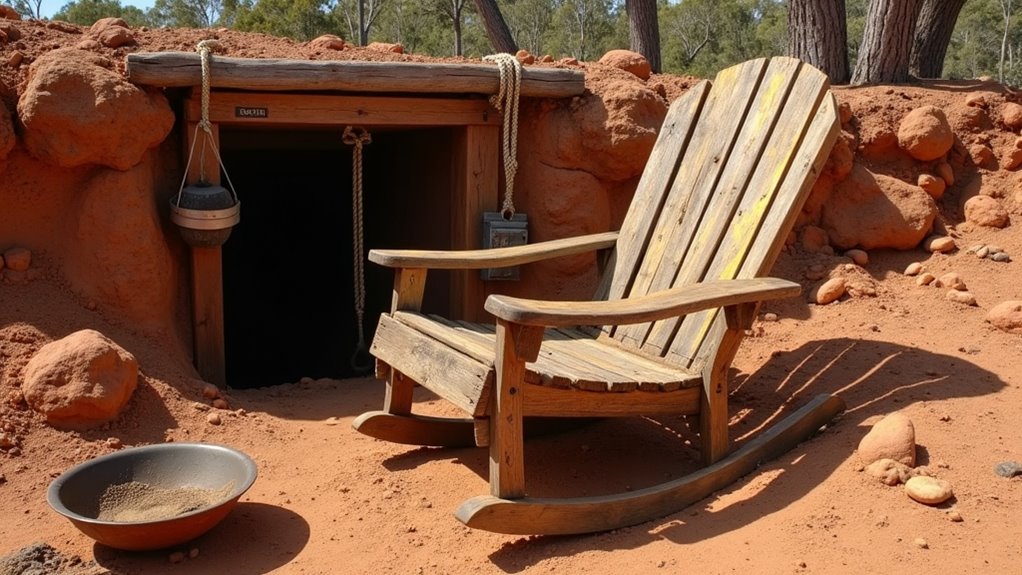
When surface gold started playing hard to get, miners went underground with shaft mining. These weren’t your ordinary holes in the ground – we’re talking one-meter squared shafts reaching depths of up to 50 meters! It took a crew of at least 3-4 miners, some serious timber props to prevent collapse, and a windlass or winch to haul up buckets of hopefully golden soil. The miners’ emphasis on functionality over aesthetics shaped their choice of equipment.
The trusty miner’s pick and shovel were like the dynamic duo of gold mining equipment. The pick broke apart stubborn rock and soil, while the shovel… well, it shoveled. Together, they made the backbreaking work of digging shafts and moving massive amounts of earth slightly less impossible.
Water management was vital in this dusty business – without it, you might as well pack up and go home. Miners used everything from simple buckets to elaborate sluice boxes, and as operations got deeper, they introduced pumps to keep their shafts from flooding. Some ambitious souls even constructed dams and races to direct water flow to their claims.
Looking back, it’s wild to think how these relatively simple tools helped fuel one of history’s greatest gold rushes. Sure, modern mining operations would laugh at this primitive equipment, but these tools literally helped build Australia’s gold mining industry from the ground up. Sometimes the simplest solutions are the most brilliant – even if they do give you a backache that’ll last until next Tuesday.
Frequently Asked Questions
How Much Did Typical Gold Mining Equipment Cost in 1800S Australia?
Basic gold mining gear in 1800s Australia ranged from dirt-cheap to eye-watering expensive.

A simple pan would set ya back 2-3 shillings, while specialized equipment like puddling machines commanded a whopping £30-50.
Essential tools like shovels (5-10 shillings) and picks (7-15 shillings) were reasonably priced.
The real kicker? Monthly license fees at 30 shillings!
Serious miners investing in water pumps faced steep costs of £50-100.

Transportation wasn’t cheap either – boat passage alone: £10-30.
What Was the Average Lifespan of Gold Mining Tools During This Period?
Mining tools had surprisingly varied lifespans.
Basic panning equipment like gold pans could last 5-10 years with proper care, while more intensive gear like sluice boxes typically survived 3-5 years.
Heavy-duty equipment showed impressive durability – stamp mills operated 10-15 years with maintenance.
The real weak links? Drill bits (lasting mere months) and canvas hoses (1-2 years).
Most wooden components needed replacement every 2-3 years due to water damage and wear.
Were There Any Women Operating Gold Mining Equipment in 1800S Australia?
Historical records confirm women did operate mining equipment in 1800s Australia, though in limited numbers.
Some worked alongside husbands on claims, handling pans, cradles, and sluice boxes. A few bold pioneers even disguised themselves as men to work independently.

The most famous case was Kitty Pluto, who not only used mining equipment but discovered an entire goldfield.
When male relatives fell ill, women sometimes took over equipment operation by necessity.
Which Australian Regions Had the Most Advanced Mining Equipment at That Time?
Victoria dominated the mining tech scene in the 1850s-60s, boasting the most sophisticated equipment of any Australian region.
Their deep lead operations in Ballarat went beyond 300 feet, using cutting-edge steam-powered pumps and winding gear.

While NSW pioneered the first rush, and WA made huge strides in the 1890s with open-cut mining, Victoria’s early engineering prowess – especially in Bendigo’s quartz reef tech – set the gold standard.
How Did Aboriginal People Influence Gold Mining Techniques and Equipment Usage?
Aboriginal people revolutionized gold mining through their intimate knowledge of the land and traditional skills.
They showed miners how to spot promising deposits using terrain markers and adapted ancient quarrying techniques for gold extraction.
Their tool-making expertise led to innovative equipment modifications, while their traditional trading routes became essential pathways to goldfields.
Their shelter designs even influenced miners’ accommodation – proving that indigenous know-how was absolutely imperative to Australia’s gold rush success.