Shaking tables and spiral separators are crushing it in the fine gold game right now. These water-based powerhouses deliver jaw-dropping recovery rates – we’re talking 98% for shaking tables and 95% for spirals. While tables excel at ultra-fine particles down to 400 mesh, spiral separators handle a broader range (75-1000 microns) at higher tonnage. Both methods dodge nasty chemicals, keeping things eco-friendly. The real magic happens when you understand the nitty-gritty details of operation.

Gold hunters, rejoice – the race to capture those elusive fine particles just got a whole lot sexier. The dynamic duo of shaking tables and spiral separators is revolutionizing the way we snag those precious yellow specs, and they’re doing it without all the nasty chemicals that make environmentalists lose their lunch.
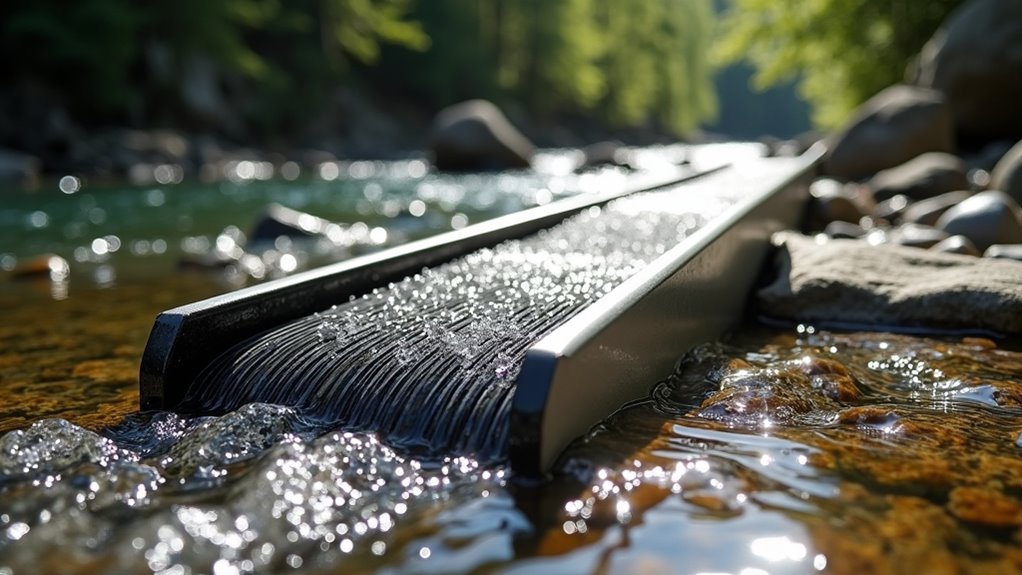
Let’s get real about these bad boys. Shaking tables are like the exotic dancers of the mineral processing world – they shimmy and shake their way to success with their riffled surfaces and precise oscillating motions. With recovery rates up to 98% for fine gold, they’re not just showing off – they’re delivering the goods. These beauties handle particles down to 400 mesh while consuming a modest 80-150 L/min of water, making them the eco-conscious choice for the discerning gold enthusiast. Their feeding size of 0-2mm makes them incredibly versatile for various mining operations. The robust mechanism delivers 130 blows per minute through a shaft with double cams for optimal separation, ensuring an efficient process that draws on traditional gold extraction methods. Additionally, these tables are often used in conjunction with other separation equipment to enhance overall recovery rates. Furthermore, incorporating sustainable practices in their design significantly reduces ecological damage during the mining process. Open pit and underground mining methods highlight the importance of selecting the right extraction technique based on the deposit type. Moreover, investing in high-quality equipment can further improve recovery rates and efficiency.
Shaking tables: the rockstars of gold recovery, turning those shimmy-shake moves into a 98% success rate for precious metal extraction.
But hold onto your hardhats, because spiral separators are bringing their own brand of gravity-defying magic to the party. Imagine this: a helical trough that gets tighter as it descends, using centrifugal force like a cosmic ballet to separate minerals based on their specific gravity. These spiraling sensations can process anywhere from 1 to 20 tons per hour, with recovery rates that’ll make your accountant blush – 90-95% for particles under 1mm.

The real kicker? Both these methods are playing nice with Mother Nature, using nothing but good ol’ H2O to do their thing. They’re the perfect tag team for both alluvial and hard rock deposits, often working in tandem like a well-choreographed dance routine. Tables excel at the super-fine stuff (20-150 microns), while spirals handle a wider range of particle sizes (75-1000 microns) like a boss.
Recent years have seen these technologies getting even more sophisticated (if you can believe it). Multi-deck shaking tables are now a thing, and automated control systems are making the whole process smoother than a gold dealer’s sales pitch. Spiral designs have evolved faster than crypto prices, and they’re integrating cutting-edge sensor-based sorting tech that would make Silicon Valley jealous.
Sure, they’ve got their quirks – tables need careful feed prep, and spirals won’t win any awards in the ultra-fine particle category. But with operating costs that’ll make chemical processing look like a luxury spa treatment, who’s complaining? The mining industry has embraced these methods faster than a prospector spotting a gold nugget, and for good reason. They’re reliable, efficient, and won’t turn your operation into an environmental disaster zone.
In the end, it’s about maximizing recovery while minimizing headaches. These gravity-based methods are proving that sometimes the old-school approach, with a modern twist, is exactly what the doctor ordered. And that’s no snake oil – its pure, gravity-separated gold.
Frequently Asked Questions
What Is the Minimum Particle Size That Shaking Tables Can Effectively Separate?
Shaking tables can effectively separate particles down to about 0.037 mm – that’s the real-world bottom limit where things start getting dicey!
While some manufacturers claim separation down to 0.022 mm, that’s pushing it.

The sweet spot hits around 0.074 mm for slime tables, but anything smaller gets tricky fast.
Physics just ain’t playing nice with those ultra-fines, folks! Viscosity and surface tension become total party poopers below these sizes.
How Often Should Maintenance Be Performed on Spiral Separators?
Spiral separators demand rigorous daily attention – no skipping!
Daily hosing and debris removal prevents buildup that’ll wreck separation efficiency.

Weekly maintenance hits the critical stuff: lubricating bearings, cleaning screens, and clearing blockages.
Monthly checks dive deeper with thorough inspections and adjustments.
But here’s the kicker – manufacturers often have specific guidelines that trump these general rules, depending on usage intensity and material characteristics.
Which Method Consumes More Water: Shaking Tables or Spiral Separators?
Spiral separators typically consume more water than shaking tables in gold processing operations.
While shaking tables operate efficiently with around 1 ton of water per hour, spiral separators demand considerably higher volumes for effective separation.
The difference is striking – tables create a thin water film, while spirals need continuous, robust flow for particle transport.
Plus, shaking tables offer better water recycling potential through simple sedimentation, making them the more water-efficient choice.
Can These Methods Be Used for Minerals Other Than Gold?
These separation methods pack serious versatility beyond just gold!
They’re workhorses in mineral processing, handling everything from tin and tungsten to rare earth elements.

Heavy minerals from beach sands? Check. Phosphate ores for fertilizers? You bet.
They’ll even tackle industrial minerals like garnet and ilmenite.
The key is density difference – if there’s at least 1 g/cm³ between materials, these bad boys can separate them with impressive efficiency.
What Is the Typical Processing Capacity per Hour for Each Method?
Shaking tables typically process 0.15-2 tons per hour, though specialized tables like the RP-4 handle just 100 lbs/hr.
That’s relatively modest compared to spiral separators, which pack a serious punch at 1-20 tons per hour!

While tables offer more precise separation (especially for those tiny gold particles), spirals are the clear winners in raw throughput.
The trade-off? Tables deliver better accuracy but require more floor space per ton processed.