Twenty-two carat gold is a stunning blend of 91.7% pure gold with 8.3% other metals, mainly silver and copper. This precise mixture creates jewelry-grade metal that’s both beautiful and practical. Silver (2-6%) adds brilliance while copper (2.8-8.4%) brings durability to the table. The result? A nickel-free alloy that’s perfect for intricate designs and sensitive skin. This golden ratio delivers exceptional corrosion resistance and workability that jewelers adore – and there’s way more to this precious story.

In the glittering domain of precious metals, 22 carat gold mixtures stand as the sweet spot between pure extravagance and practical durability. This coveted alloy consists of 91.7% pure gold, with the remaining 8.3% being a carefully orchestrated blend of other metals, primarily silver and copper, each playing an essential role in enhancing the final product’s characteristics. Additionally, the composition of 18k yellow gold alloy typically features a similar ratio of gold content but with different metal mixtures that influence its overall properties.
The genius behind this mixture lies in its precise balance of components. Silver, ranging from 2-6%, not only adds a subtle brilliance but also contributes to the alloy’s workability. Copper, typically present between 2.8% and 8.4%, brings the much-needed muscle to the mix, improving durability without compromising the metal’s iconic yellow hue. It’s like watching a metallurgical ballet where every element knows its exact steps. Solid gold is often perceived as the highest standard, yet 22 carat gold offers a remarkable balance. The use of common gold alloys in various industries highlights the versatility and practicality of these mixtures.
This composition achieves remarkable physical properties that would make any metallurgist grin with satisfaction. The alloy maintains exceptional corrosion resistance while reaching impressive hardness levels of up to HV274 through advanced processing. Perhaps most remarkably, it can undergo cold rolling exceeding 99% without throwing a tantrum – no cracking or need for annealing breaks.

The jewelry industry has embraced 22 carat gold with particular enthusiasm, especially in markets where tradition meets craftsmanship. Its ability to balance softness with durability makes it perfect for intricate designs, while its nickel-free formulation keeps it friendly to sensitive skin. The alloy’s high fluidity during casting is like having a cooperative partner in crime, enabling jewelers to create increasingly complex pieces.
What’s particularly fascinating is how this mixture performs in the workshop. The material can be reused multiple times before requiring refinement, thanks to reduced copper oxidation. It plays nice with existing jewelry-making equipment, and its lower casting temperatures make it less of a drama queen during production compared to other gold alloys.
In cultural terms, 22 carat gold is practically royalty in markets like India, where it’s considered the gold standard for ornamental jewelry. It strikes an impressive balance between investment value and practical utility, making it a favorite for wedding jewelry and ceremonial pieces. Compared to its siblings in the gold family, it offers superior value retention than 18k or 14k while providing better durability than pure 24k gold. Additionally, 22 carat gold is more widely recognized for its durability and aesthetic appeal, making it a popular choice among consumers.
The alloy’s versatility extends beyond traditional applications, supporting both elaborate and minimalist designs with equal grace. Its rich yellow color closely mimics pure gold while offering considerably better mechanical properties, making it the go-to choice for jewelers who refuse to compromise between beauty and functionality.

Fundamentally, the 22 carat gold mixture represents a masterclass in metallurgical engineering, where science meets artistry in perfect harmony.
Frequently Asked Questions
How Can I Test if My Gold Jewelry Is Genuine?
Testing gold’s legitimacy isn’t rocket science – but it’s close!
The magnet test‘s a classic (real gold tells magnets to buzz off), while the trusty hallmark inspection reveals those essential “K” markings.
For the brave souls out there, nitric acid testing exposes fakes with a satisfying fizz.

And if you’re feeling sciency, there’s always the density test – because genuine gold sinks like your bank account after buying it!
Why Does Pure Gold Tarnish When Exposed to Certain Chemicals?
Here’s a key misconception – pure gold (24K) actually doesn’t tarnish!
It’s one of the most chemically stable metals out there. What people often mistake for “pure gold tarnishing” is actually the reaction of other metals mixed into gold alloys.
Those pesky metals like copper and silver are the real culprits, reacting with sulfur, chlorine, and other environmental chemicals.
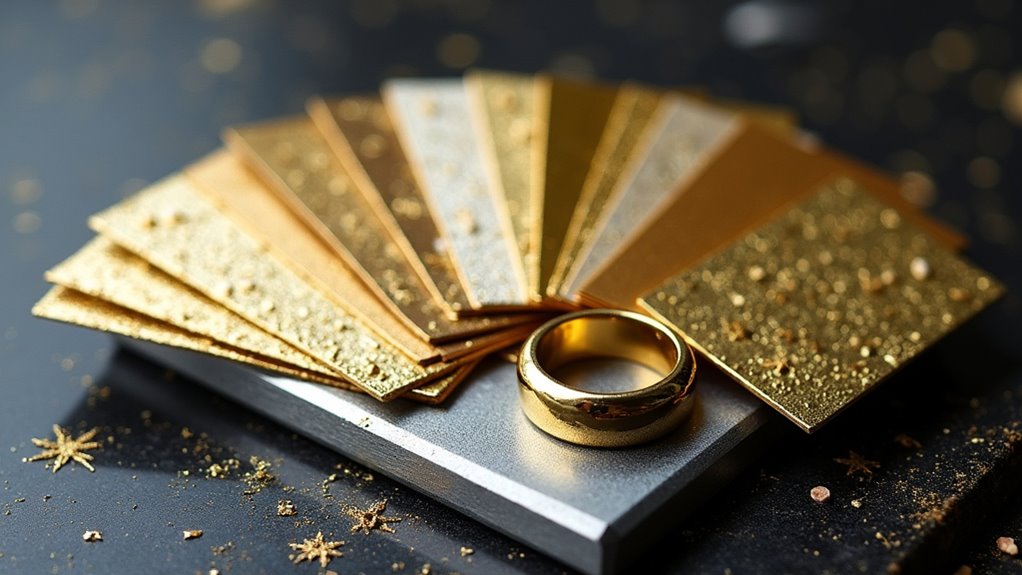
Pure gold just sits there, smugly immune to tarnish while its alloyed cousins suffer.
Can I Mix Different Carats of Gold Together?
Yes, different carats of gold can be mixed together through melting, but it’s not as simple as throwing pieces in a pot!
When combining different carats, the result averages between the original values – mix equal parts 9ct and 18ct, you’ll get roughly 13.5ct.
But here’s the catch: proper mixing requires precise calculations and often needs additional metals to achieve desired properties.

The process demands expertise ’cause mistakes can lead to wonky compositions and lower values.
What Causes Gold Allergies in Some People?
Gold allergies primarily stem from metal ions released when gold alloys corrode on skin contact.
Here’s the kicker – it’s often not pure gold causing trouble, but those sneaky other metals mixed in!
The usual suspects? Nickel and copper, notorious allergens lurking in lower-karat pieces.

When these metals hit sweat or cosmetics, they trigger Type IV hypersensitivity reactions.
Women get hit harder, thanks to more jewelry exposure and piercings – talk about unfair!
How Do Environmental Factors Affect the Longevity of Gold Jewelry?
Environmental factors can absolutely wreak havoc on gold jewelry’s lifespan!
Moisture’s the big baddie here – everything from shower steam to pool chlorine slowly chips away at that precious shine.
Chemicals are brutal too; everyday products like perfumes and lotions wage a sneaky war against gold’s surface.
Heat and temp changes? They’re notorious for creating micro-cracks, while good ol’ friction from daily wear gradually erodes the metal’s surface.
Mother Nature’s got quite the arsenal!