Gold alloy necklaces pack serious personality depending on their karat count. The classic 14k strikes that sweet spot between durability and bling factor, while 18k brings extra flash but needs babying. White gold rocks that modern vibe with its rhodium coating, and rose gold? Total glamour thanks to copper’s rosy touch. Smart shoppers check for clear hallmarks and smooth soldering – because nobody’s got time for sketchy pieces. There’s more to this precious metal party than meets the eye.

Maneuvering the glittering world of gold alloy necklaces can feel like decoding an ancient alchemist’s handbook – but it doesn’t have to.
Gold necklaces come in various karats, each telling its own story of purity and practicality. The most common options – 10k, 14k, and 18k – represent different percentages of pure gold mixed with other metals. While 24k might sound luxurious, it’s actually too soft for jewelry that’s meant to last (seriously, you could bend it with your bare hands). That’s why jewelers prefer working with alloys that bring both beauty and brawn to the table. Understanding gold purity is key to making an informed choice, especially when considering the white gold alloy metals that contribute to its durability and appeal. Furthermore, knowing the specific composition of 14k and 18k white gold can greatly assist in your decision-making process.
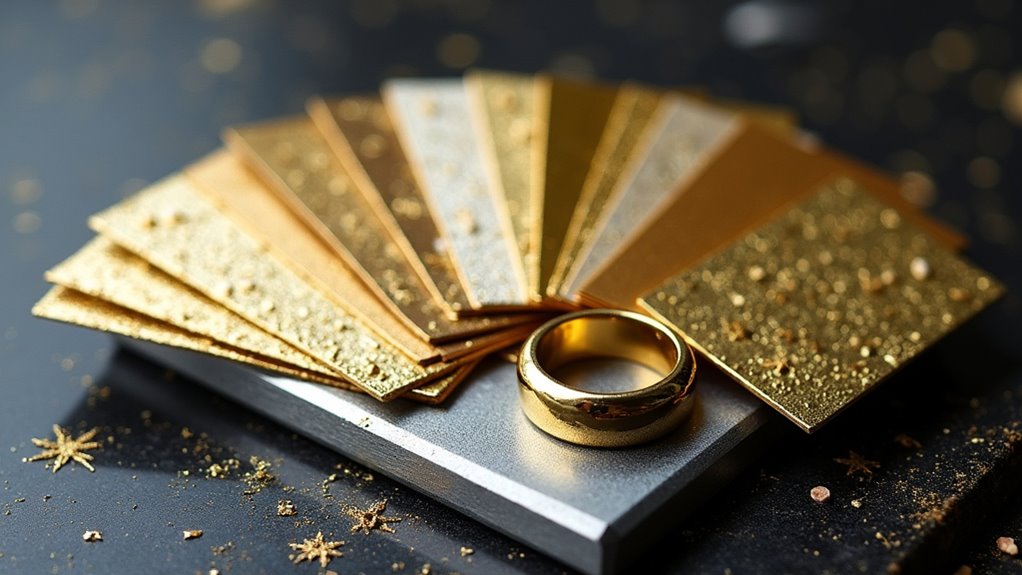
Let’s talk color chemistry, because this is where things get interesting. Yellow gold gets its classic warmth from a copper-silver combo, while white gold owes its icy gleam to metals like palladium or nickel (plus a rhodium coating that’s basically jewelry’s version of a power suit).
Gold’s beauty lies in its partnerships – yellow warms up with copper and silver, while white gold stays cool with rhodium’s sophisticated touch.

Rose gold? That’s what happens when copper crashes the party in higher proportions, creating that Instagram-worthy pink hue that’s been trending since, like, forever.
Durability isn’t just about surviving your morning coffee run – it’s about lasting through life’s adventures. Lower karat pieces, like 10k and 14k, can handle the daily grind like a champ. Meanwhile, those gorgeous 18k pieces might need to be saved for special occasions, unless you’re cool with collecting battle scars on your investment.
And speaking of investments, proper verification is vital: legitimate pieces always come stamped with their karat mark (think “585” for 14k or “750” for 18k). Additionally, understanding the common gold alloys used in jewelry can help you make more informed choices about what best suits your style and needs.
Here’s where things get real: pricing. Higher karats mean higher prices, but don’t let that fool you into thinking more expensive always equals better. For most people, 14k hits the sweet spot between affordability and durability. It’s like getting a sports car that can actually handle grocery runs – practical luxury at its finest.

The market’s been doing its usual dance lately, sending prices on their typical roller coaster ride.
Smart shoppers know to check for quality markers beyond just the stamp. Look for smooth soldering points, sturdy clasps that click with satisfying precision, and prongs that grip any gemstones like they’re holding on for dear life.
And please, for the love of all things precious, stick with reputable sellers who can actually explain what they’re selling. Those too-good-to-be-true deals floating around online? They’re usually exactly that – too good to be true.
When it comes to skin sensitivity, some folks need to be extra careful with their alloy choices. Nickel-free options exist for a reason, and any jeweler worth their salt will help guide you toward hypoallergenic options that won’t turn your neck green or cause a rash (because nobody’s got time for that drama).
Frequently Asked Questions
How Should I Store My Gold Alloy Necklace When Not Wearing It?
Store those precious gold alloy beauties in style! Individual velvet-lined compartments or hooks are absolute must-haves – no tangling drama here.
Keep temps between 65-75°F and humidity at 45-50% (yeah, science matters). Throw in some anti-tarnish strips and silica gel packets for extra protection.

And please, keep em’ away from your steamy bathroom! Regular check-ups guarantee these babies stay pristine.
Just remember: separate storage equals happy necklaces.
Can I Wear My Gold Alloy Necklace While Swimming?
No way – wearing gold alloy necklaces while swimming is a recipe for disaster!
Chlorine’s basically kryptonite for these beauties, wreaking absolute havoc on the metal’s structure.
It’ll turn that gorgeous piece into a brittle, dull mess faster than you can say “cannonball.”
The chlorine attacks those alloy metals – copper, zinc, nickel – like a hungry shark.
Even high-karat pieces aren’t immune to this chemical assault.
Best keep those precious chains dry n’ safe!
How Often Should I Have My Gold Alloy Necklace Professionally Cleaned?

Professional cleaning every six months is the gold standard for necklace maintenance – pun absolutely intended!
While some jewelers push for quarterly visits (ka-ching!), twice-yearly deep cleans hit the sweet spot.
But here’s the real deal: daily wear means more frequent cleanings. Swimming, sweating, or living in humid climates? Bump it up to every 4 months.
Those special-occasion pieces chillin’ in storage? Annual check-ups’ll do just fine!
Will My Gold Alloy Necklace Trigger Metal Detectors at Security Checkpoints?

Gold alloy necklaces might set off metal detectors, but it’s not a given! The likelihood depends on factors like karat purity and size.
Lower karat pieces (14K-18K) are more conductive thanks to those mixed metals, making them more detectible than pure 24K gold.
Here’s the kicker – chunky chains and layered pieces are basically asking for a security pat-down!
Pro tip: stick to simple, lightweight designs if ya don’t wanna be “that person” holding up the line.
Can I Get My Gold Alloy Necklace Resized if Needed?
Most gold alloy necklaces can be resized, but it’s not always a slam-dunk! The feasibility depends on the specific alloy and design – 14K and 18K pieces are typically more cooperative than their fussier cousins.
Simple chains? Easy peasy. But those fancy numbers with gemstones might give jewelers a headache.
Pro tip: your local jewelry wizard should assess the piece first, since some designs just won’t play nice with resizing. The process usually involves adding or removing links.