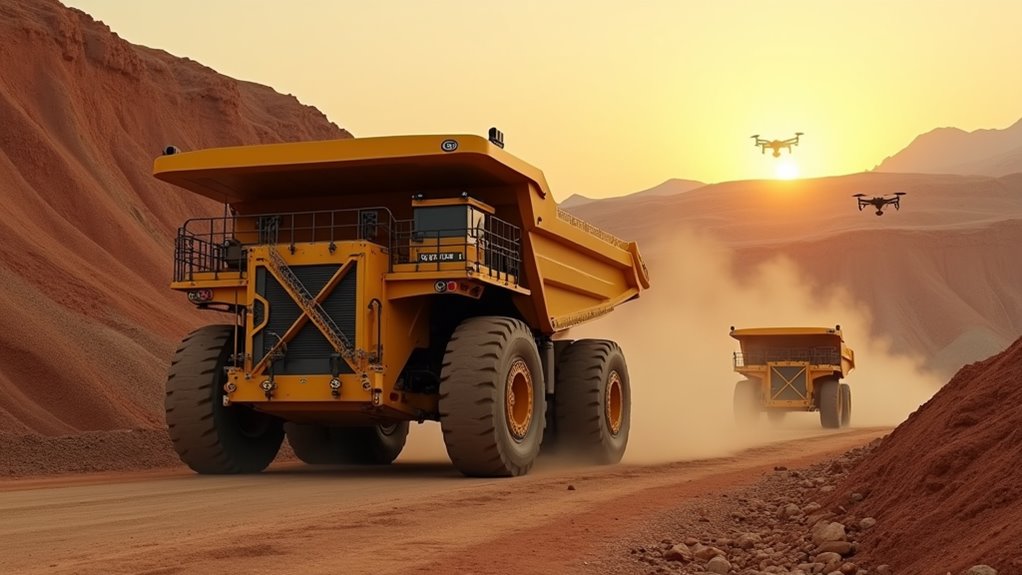

Autonomous vehicles are revolutionzing gold mining, and it’s about time! First deployed in Chile (2007), these AI-powered behemoths run 24/7 without coffee breaks or sick days. They’ve slashed production costs – just ask Resolute Mining, who’s saving $135 per ounce. Equipped with GPS, LiDAR, and enough sensors to make Tesla jealous, these machines boost efficiency by 30% while keeping humans out of harm’s way. The future of mining gleams even brighter than the metal it extracts.

The future of gold mining just got a whole lot shinier – and it’s got nothing to do with the metal itself. Since Komatsu’s groundbreaking deployment in Chile back in 2007, autonomous haulage systems have been revolutionizing the way we dig up earth’s most precious metal. And let’s be real, these aren’t your grandpa’s dump trucks – we’re talking about sophisticated machines that never need a coffee break or call in sick.
These metal beasts are equipped with more tech than a Silicon Valley startup – GPS navigation that’s accurate enough to make your smartphone blush, LiDAR systems that can spot a pebble from 50 meters away, and AI brains that make split-second decisions better than most humans. The real kicker? They’re slashing production costs faster than a gold trader can say “bullish market.” Just look at Resolute Mining in Mali, where they’ve managed to knock down costs by $135 per ounce – that’s nothing to sneeze at. At Boddington mine, the implementation of autonomous haul trucks marks a historic milestone as the first-ever deployment in open pit gold mining. The integration of advanced sensors has dramatically improved hazard detection and overall mine safety, showcasing a significant leap towards sustainable mining practices. Moreover, these systems are also paving the way for AI-driven prospecting, enhancing the efficiency of finding new gold deposits. In contrast to underground mining, where conditions can be far more hazardous, open pit methods allow for more straightforward integration of these autonomous systems. Interestingly, aerial mapping using drones in gold exploration has become a complementary tool in optimizing site analysis and data collection for these automated operations.
But here’s where it gets really interesting (yes, we meant to spell it that way – keeps things authentic): these autonomous vehicles are working 24/7, adding up to 1,000 extra hours of operation annually per vehicle. No bathroom breaks, no shift changes, just pure, uninterrupted productivity. Mining companies are seeing their operational costs plummet by up to 30% with fully autonomous operations, and worker safety? Through the roof, since humans aren’t hanging around in those hazardous pits anymore. This is particularly significant given the importance of workplace hazard prevention in maintaining a safe mining environment.

Of course, it ain’t all sunshine and gold nuggets. The initial investment costs are enough to make any CFO sweat, and maintaining reliable wireless connectivity in the middle of nowhere is about as fun as trying to find a needle in a mountain of pyrite. Plus, there’s the whole cybersecurity thing – because apparently, hackers aren’t just interested in your crypto wallet anymore.
The environmental impact is worth its weight in gold too (see what we did there?). These smart machines are actually helping reduce fuel consumption and emissions, while their precise operations mean less environmental disruption. They’re like the Tesla of the mining world, except they’re actually making money.
Looking ahead, the industry’s buzzing about integrating predictive maintenance using AI and IoT, and some companies are even eyeing autonomous underground operations. Newmont’s success at Boddington in 2021 was just the beginning – we’re watching the birth of a new era in mining, where machines do the heavy lifting while humans focus on the big-brain stuff.
Bottom line? Autonomous vehicles in gold mining aren’t just a fancy tech trend – they’re reshaping the entire industry faster than you can say “digital transformation.” And while some old-timers might grumble about robots taking over, the numbers don’t lie: this is one technological revolution that’s definitely worth its weight in gold.
Frequently Asked Questions
How Does Weather Affect the Performance of Autonomous Vehicles in Mining Operations?
Weather throws major curveballs at mining AVs – and boy, do they feel it!

Rain slashes radar detection by 55%, while those pesky dust storms in desert ops make sensors work overtime.
But these metal beasts ain’t giving up: they’re packin’ multi-sensor systems that cut through fog and snow like butter.
When conditions get nasty, these smart trucks know when to pull over, keepin’ operations safe n’ steady.
Still, Mother Nature loves testin’ their limits!
What Is the Average Lifespan of Autonomous Mining Vehicles?
Autonomous mining vehicles typically survive 5-7 years in the field, though that’s just the baseline.

With proper maintenance, these mechanical workhorses can stretch their operational life by an impressive 20-30%.
The real kicker? Battery systems usually tap out at 3-5 years, depending on how hard they’re pushed.
Smart maintenance and high-quality components are game-changers – they’re literally the difference between an early retirement and a extended career in the pit.
Can Existing Mining Vehicles Be Retrofitted With Autonomous Technology?
Absolutely – retrofitting existing mining vehicles with autonomous tech is a game-changer!
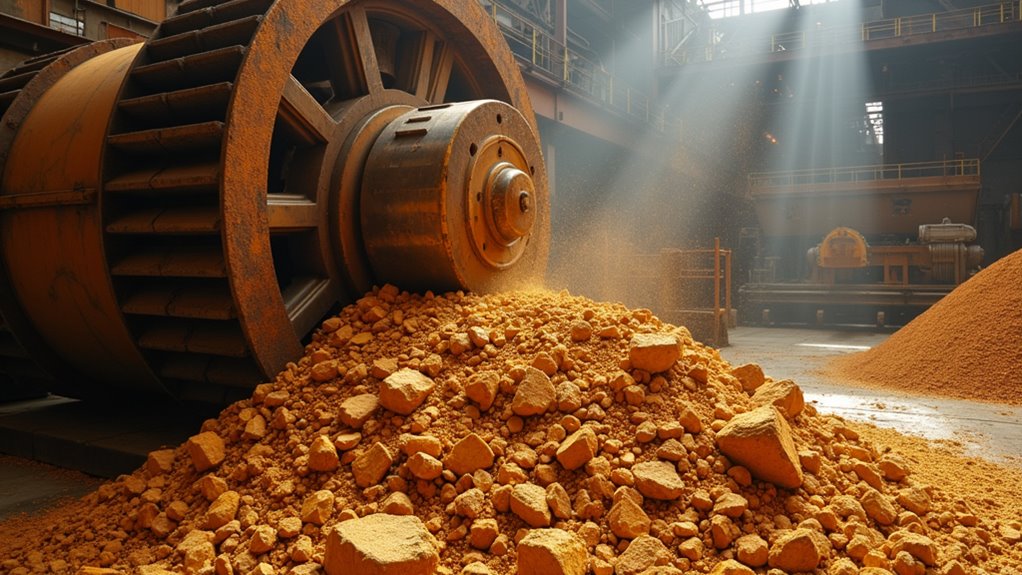
Companies like SafeAI are transforming old-school trucks into smart machines by slapping on drive-by-wire controls, sensors, and brainy software.
The upgrade boosts productivity by 30% and adds a sweet 1,000 hours of annual operation time.
While it’s not exactly plug-and-play (there’s some serious tech integration involved), it’s way cheaper than buying shiny new autonomous vehicles.
How Are Cybersecurity Threats Managed in Autonomous Mining Systems?
Mining companies tackle cyber threats with a multi-layered defense strategy – kinda like Fort Knox but for data!

They’re deploying AI-powered security systems that spot suspicious activity faster than a prospector spots gold.
Network segmentation keeps critical systems isolated, while continuous monitoring watches for digital intruders 24/7.
Regular security updates patch vulnerabilities, and strict access controls guarantee only authorized personnel get in.
It’s basically a digital fortress protecting those precious autonomous operations.
What Backup Systems Exist if Autonomous Vehicles Fail During Critical Operations?
Autonomous vehicles pack multiple layers of backup systems for critical failures.

The primary defense involves redundant navigation using GPS and inertial systems, while RTK positioning provides precise location data.
If systems fail, remote operators can instantly takeover through low-latency video feeds and teleoperation controls.
Mechanical fail-safes include emergency braking and steering overrides, while uninteruptible power supplies guarantee continuous operation.
Vehicles automatically enter safe-park mode during major malfunctions.