In-house gold assaying labs deliver lightning-fast results with a 10% margin of error, while third-party facilities offer precision at the cost of time. The choice boils down to operational scale – smaller producers often find third-party services more cost-effective, while larger operations benefit from in-house economies of scale. Third-party labs bring heavyweight credibility with certified reports and standardized protocols, though that reputation comes with longer wait times and shipping hassles. There’s more to this golden puzzle than meets the eye.
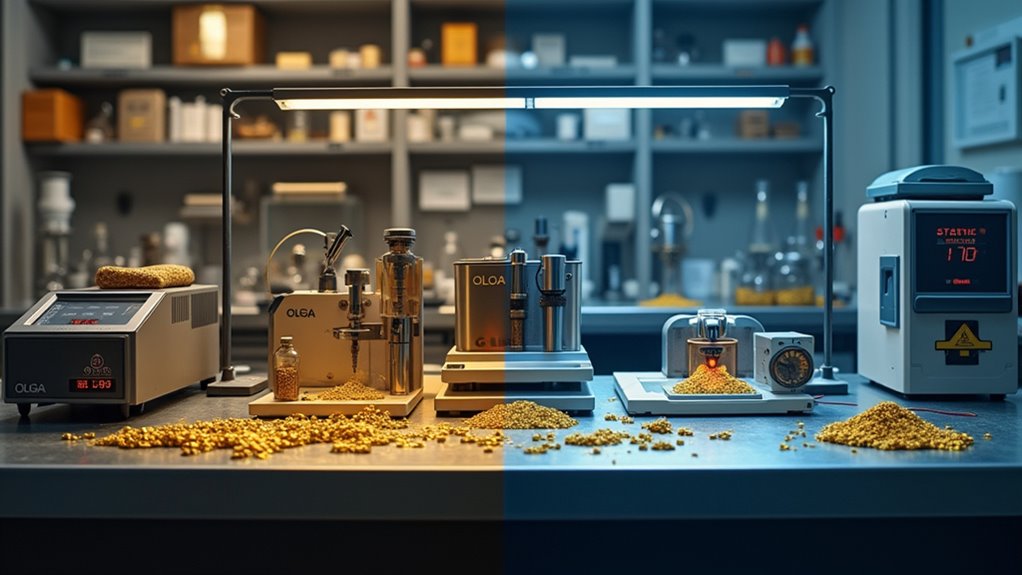
When it comes to gold assaying, choosing between in-house and third-party labs isn’t just about crunching numbers – it’s about striking that perfect balance between speed, accuracy, and cold hard cash. The financial calculus isn’t exactly straightforward, with in-house facilities demanding hefty upfront investments in specialized equipment and infrastructure, while third-party labs charge by the sample and might actually be cheaper for smaller operations.
Speed is where in-house labs really shine, offering lightning-quick results that keep mining operations humming along without those nail-biting delays. Third-party services, meanwhile, involve the whole shipping-and-waiting game, which can drive operations managers absolutely bonkers. Modern in-house tech like OLGA systems delivers near-instant results, though you’ll sacrifice a bit of accuracy for that speed – we’re talking about a 10% margin of error here, folks. Moreover, in-house methods can be less reliable than industrial gold refining techniques when it comes to processing large volumes. Additionally, effective metal recovery techniques can further enhance overall operational efficiency. A notable challenge is that traditional methods often involve harmful substances like cyanide and mercury, which are being replaced by safer alternatives in modern refining practices.
Speed makes in-house labs shine, but that blazing-fast turnaround comes with a trade-off: less precision for more production pace.
But here’s where things get interesting: accuracy and reliability tend to favor the external pros. Third-party labs are basically the gold standard (pun totally intended) when it comes to precise measurements, thanks to their tried-and-true gravimetric and fire assay methods. They’ve got the expertise, the cutting-edge equipment, and those all-important standardized protocols that make investors feel warm and fuzzy inside. Additionally, the classification of gold as a Tier 1 asset under Basel III significantly impacts how banks manage their capital reserves and risk exposure.

Flexibility is another vital factor that’s worth its weight in, well, gold. In-house labs can pivot on a dime to handle varying sample volumes and unique testing requirements, but scaling up often means more investment in equipment and training. Third-party labs, on the other hand, come ready-made for handling massive sample volumes without breaking a sweat.
The expertise factor can’t be ignored – setting up an in-house lab means recruiting and retaining skilled specialists who know their way around a gold assay. That’s no small feat in today’s job market. Third-party labs already have seasoned veterans on staff, keeping pace with the latest industry developments while you focus on actual mining operations.
Quality control is where third-party labs really flex their muscles. They undergo regular audits, maintain rigorous standards, and provide certified reports that carry serious weight in disputes. In-house labs can certainly maintain high standards, but without proper checks and balances, there’s always the risk of developing tunnel vision or unconscious biases in testing procedures.
The bottom line? The choice between in-house and third-party labs depends on your operation’s specific needs, scale, and resources. Larger producers might benefit from the economies of scale with in-house facilities, while smaller operations could find third-party services more cost-effective.

Many successful operations actually use both, leveraging in-house labs for quick operational decisions while using third-party verification for official reporting and quality assurance. It’s not about picking sides – it’s about finding the right mix for your golden ambitions.
Frequently Asked Questions
What Certifications Should I Look for in a Gold Assaying Lab?
A legit gold assaying lab needs serious credentials – ISO/IEC 17025 is the big kahuna here, showing they’ve got the technical chops.
LBMA accreditation? That’s gold-standard stuff (pun intended!).
Smart money also looks for RJC certification and Good Delivery Lists approval.

For extra peace of mind, check if they’re rocking ISO 9001 and those fancy third-party audits.
Without these badges, you’re basically trusting your gold to amateurs!
How Long Does a Typical Gold Assay Process Take?
Gold assay timing varies dramatically based on the chosen method.
Fire assaying, the gold standard (pun intended!), takes a grueling 5 hours to complete – but hey, perfection takes time.

XRF analysis, the sprinter of the assaying world, delivers results in mere minutes. Though it’s lightning-fast, XRF sacrifices some accuracy for speed.
Sample prep and lab efficiency can stretch these timeframes, while factors like sample size and complexity might throw a wrench in the works.
Can Temperature and Humidity Affect Gold Assay Results?
Environmental conditions can greatly impact gold assay results.
Temperature fluctuations create havoc – causing up to 2% error for every 10°F shift and messing with chemical reaction rates.

Meanwhile, humidity‘s no friend either, especially when it creeps above 60%.
The deadly combo of heat and moisture accelerates corrosion in lower-purity samples and throws off precision measurements.
Smart labs maintain strict climate control around 72°F with low humidity to keep results reliable.
What Happens if There Are Discrepancies Between Different Lab Results?
When labs disagree on gold assay results, it triggers a chain of eyebrow-raising events.
First, they’ll cross-check against industry standards – because nobody likes a mystery metal moment!

If the head-scratching continues, destructive testing might be necessary (bye-bye, pretty sample).
Labs run statistical analysis to spot those pesky outliers, and sometimes they’ll even call in the original refinery.
Meanwhile, everyone’s counting their pennies cause these disputes ain’t cheap to resolve!
Are Portable XRF Analyzers Reliable for Preliminary Gold Testing?
Portable XRF analyzers pack serious reliability for initial gold testing, delivering quick results without destroying samples.
These tech-savvy gadgets can detect up to 27 elements with impressive accuracy – when properly calibrated, of course.
Sure, they’ve got their quirks with gold-filled items and complex alloys, but for rapid screening? They’re golden.
Just don’t expect them to replace traditional fire assays for those high-stakes transactions where precision is everything.